


How to protect first-time homebuyers from cash to close wire fraud
Cash to close is the largest payment most buyers will ever send, and the one fraudsters target most. Here's the six-step plan that keeps it safe.
Share article:


Katie Stewart
4 minutes
Cash to close
Jul 30, 2026
Aug 13, 2026
Quick Summary
Cash to close is the biggest payment most first-time homebuyers will ever make, and fraudsters target it more than any other payment during closing. Here’s how your team can help them lower that risk:
- Warn the buyer early, before instructions ever go out
- Secure every email account connected to the closing
- Verify the buyer's identity and validate bank details before you collect a dollar
- Take the payment off the emailed wire entirely
- Call to confirm any payment that still moves by wire
- Keep a fast recovery plan ready before you need it
Why first-time buyers are the easiest target at the closing table
A first-time buyer has probably never sent a six-figure payment before. They have no idea what your wiring instructions are supposed to look like, so a fraudulent set of instructions reads just as legitimate as the real one, through no fault of their own. That’s exactly why fraudsters target them.
Our 2026 State of Wire Fraud Report found that buyer cash to close fraud was the most common type in 2025, with a median loss of $239,850. First-time home buyers are roughly three times more likely to fall victim than repeat buyers.
When it happens, the buyer is the one dealing with the loss, before anyone gets to the question of liability. This guide walks through six steps your team can take to protect a first-time buyer from that outcome.
Why listen to us
We’ve protected $1.46 million in real estate closings in 2025 and secured $1.4 billion in buyer and seller funds in 2024. Every year, we publish the State of Wire Fraud Report, the most-cited read in the industry on how these scams unfold. Cash to close is the payment criminals hit most, and protecting those high-risk transfers is a huge part of what our platform does.
How cash to close works
Cash to close is the total amount a buyer needs to bring on closing day: down payment plus closing costs, minus earnest money already paid. For many first-time buyers, it shows up in the file as a single six-figure number a week or two before closing, the largest payment they’ve ever made.
Cash to close fraud is a form of business email compromise, or BEC. A fraudster gains access to, or impersonates, an email account associated with the transaction. It could belong to the buyer, the real estate agent, the lender, or the title company. In many cases, the fraudster never breaches a secure system at all. They simply monitor the conversation, learn who is involved, and wait for the right moment. A day or two before closing, they send the buyer new wiring instructions that route the money to an account they control.
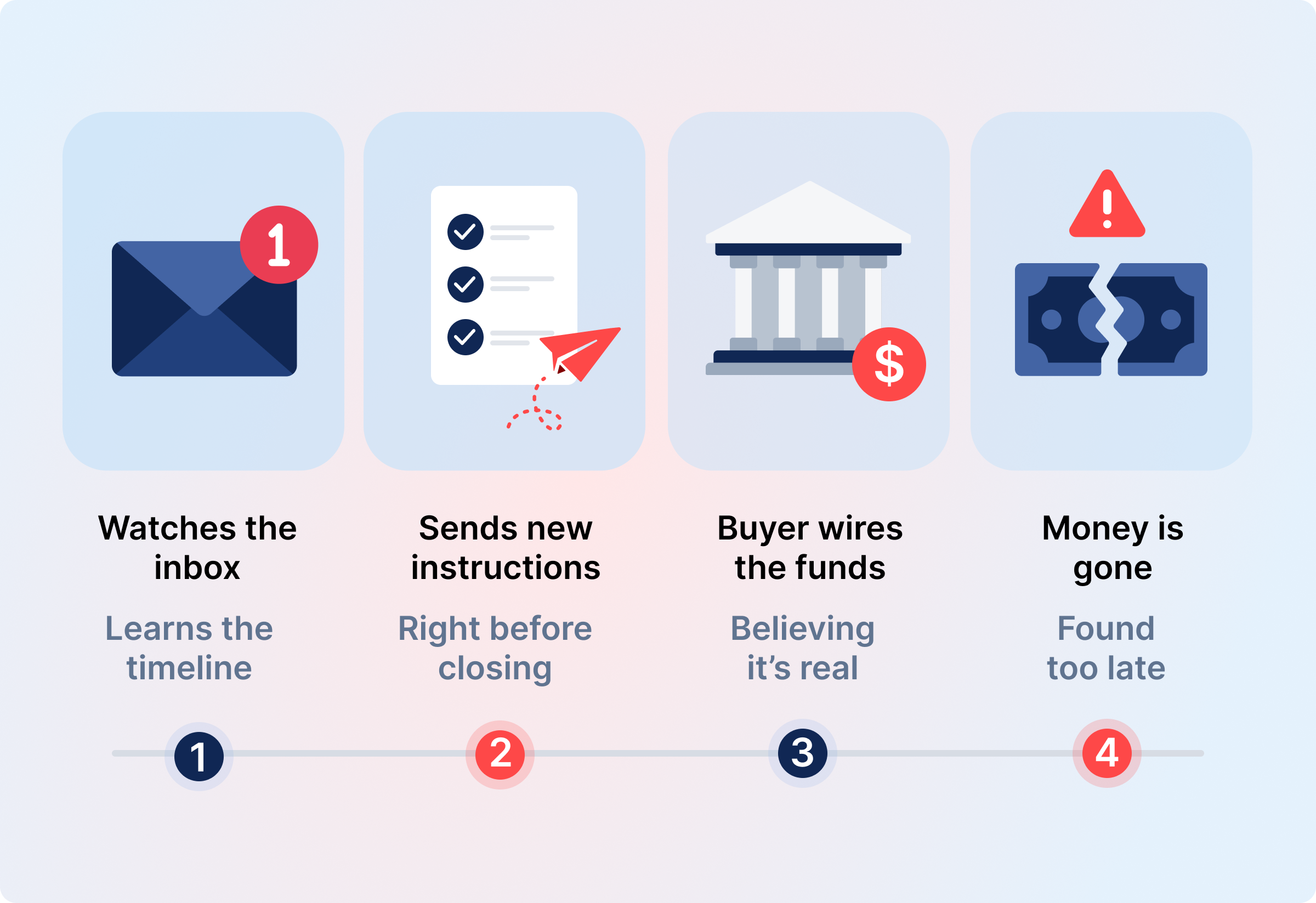
Toni Powell, a buyer near Cincinnati, got an email that looked exactly like it came from her title company, down to her agent's photo. It asked her to pay her closing costs before noon, and she wired $7,542. At her real closing, she learned her title company never sent the email. Her bank wouldn't reverse the transfer, because she had sent the money herself; she had no way of knowing the email wasn't real. That's what makes this fraud so effective.
Because the buyer authorized the payment, the bank treats it as a legitimate transfer, and a legitimate transfer is very hard to claw back once it goes through. That’s why every safeguard has to be in place before the buyer sends the money.
How to protect first-time homebuyers from cash to close payment fraud
1. Warn the buyer early, before instructions go out
Your strongest first line of defense is a buyer who already knows the scam is coming, and first-time buyers are the least prepared for it. So the warning has to come at the very start of the file.
Tell them your wiring details will never change. Any email, text, or call asking them to send money somewhere new is fake until they confirm it with you by phone. Explain this on the first call, then repeat it in writing: in the engagement letter and directly on the wiring instructions.
It also helps to agree on a simple code phrase up front, one only you and the buyer know. You both use it to confirm where the money goes, and a fraudster reading the thread won't have it.
2. Secure every email account connected to the closing
Cash to close fraud rarely starts with the payment itself. It starts weeks or even months earlier, when a fraudster quietly gets into an email account and quietly follows the closing from the inside. Lock down the emails, and the attack never gets far enough to reach the buyer.
Start with your own team, then work your way outward:
- Enable multi-factor authentication for every email account at your title company, with no exceptions. One unprotected account is all a fraudster needs to get in.
- Set up SPF, DKIM, and DMARC on your domain; together, these email authentication standards make spoofed messages that borrow your title company’s name far more likely to bounce or land in spam.
- Train the team to spot a lookalike domain, the kind that swaps an "m" for "rn" or slips in an extra letter you'd miss under a strict deadline.
It's tempting to assume the risk lives only in the buyer's inbox. In many files, the compromised account belongs to the agent or to you, since that's where the wiring instructions originate from. A fake sent from a familiar closing address is the one a first-time buyer will never think to question.
The ALTA Best Practices framework covers the baseline controls underwriters increasingly expect, and it doubles as a checklist for hardening this channel. Our guide on how title agents can prevent real estate fraud goes deeper on the operational side.
3. Verify identity and validate bank details before you collect a dollar
Every party to the payment should be confirmed before any money is requested. You verify who the buyer is, and you validate where the money is going. Those are two separate checks, and a first-time buyer's payment needs both.
Confirming the buyer’s identity doesn’t prove the account details are legitimate. Validating the escrow account doesn’t tell you whether the person initiating the payment is really the buyer named in the file.
Start with identity. Don’t rely on a name and email address alone. CertifID’s identity verification uses device signals, multi-factor authentication, and dynamic knowledge-based questions to confirm the buyer is who they say they are, then screens the file against 150 fraud markers before clearing it.

Then verify the receiving account on your own, without relying on the buyer to do it. Your team should set up and validate the escrow account directly, so the buyer never has to trust an account number copied from an email with no reliable way to check it.
Handled this way, you also keep a record that the person paying is the person named in the file. The mistake to avoid is treating verification as a one-step process at intake. Identities and account details can change late in a file, so run the check again close to the payment itself.
4. Take cash to close off the emailed wire entirely
Every step so far makes the emailed wire safer. This one removes it. The surest way to stop a spoofed wiring email is to make sure there's no wiring email to spoof in the first place. Take it away, and the most targeted payment in the closing has nothing left to intercept.
CertifID Cash to Close moves the biggest payment in the file off the wire and into one connected closing experience that the buyer can run from their phone.
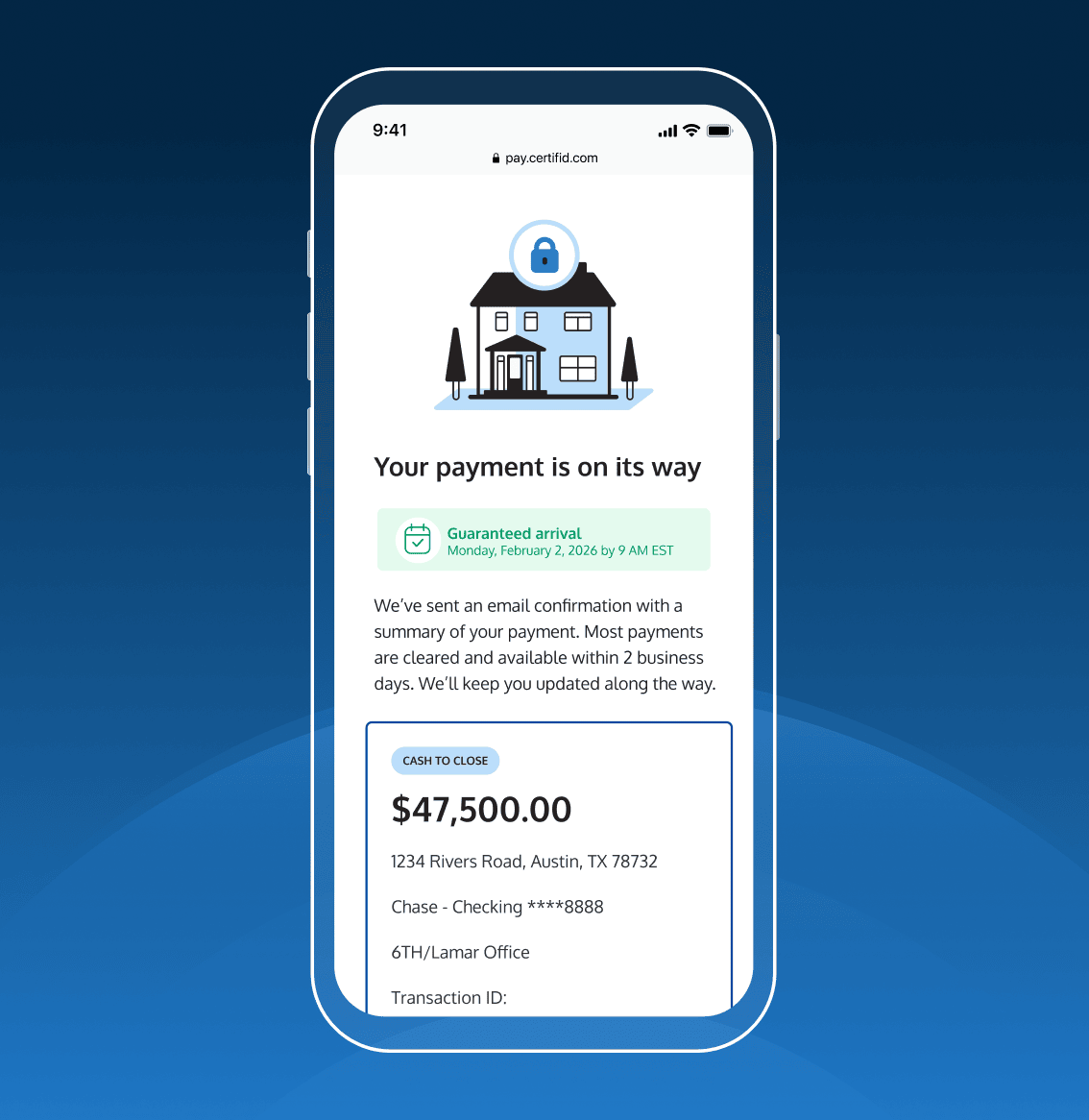
Your team sends the buyer a payment request straight from the portal, pre-filled with the exact amount and the escrow account you’ve already set. The buyer connects their bank, confirms the amount, sees their exact delivery date, and pays in a few minutes. They never touch wiring instructions, and they can't change the destination or the amount.
As long as the buyer submits by 11:59 pm ET, the funds are delivered to escrow at 8:00 am ET the next business day. Once they arrive, the payment is final and never subject to clawback. If a payment is ever returned after reaching escrow, CertifID handles the recovery, so your team does not have to spend time chasing it.
No buyer is ever left at a dead end. If they can't complete the digital payment for any reason, the system automatically directs them to your verified wiring instructions, so nobody is stuck improvising the night before closing. The buyer pays a $48 flat fee, regardless of how much they're sending.
For a first-time buyer, this turns the hardest payment into the easiest one. What used to mean a confusing email and a trip to the bank branch becomes a few taps on a phone, and the single instruction that criminals want most to forge no longer exists anywhere in the file.
5. Call to confirm any payment that still moves by wire
Some closings will still settle by traditional wire, and that's fine, as long as the buyer isn't left to protect a six-figure payment alone. A first-time buyer needs a verification routine that you walk them through in person. A single line in an email telling them to "be careful" won't carry a payment this size. The Consumer Financial Protection Bureau's guidance on closing fraud is a solid backbone to build yours on.
Set it up with the buyer early, so the routine is already in place before instructions ever go out:
- Give them two trusted phone numbers, yours and their agent's, both pulled from your own paperwork and never from an email signature.
- Agree that the buyer will call one of those numbers to confirm the account before sending, every single time, even when nothing looks wrong.
- Tell them plainly that no instruction will ever arrive by email alone at the last minute, so a surprise change is their cue to stop and call.
The callback works for a simple reason: a fraudster who controls the inbox still can't answer your office line. That step matters more now than ever, because fraudsters now use AI to mimic a familiar voice or write a flawless email in your style. First-time buyers skip the call anyway, for the same reason they miss the scam in the first place, hey assume the email is enough. Walk them through it once on a live call, so they already know who to reach and what to ask when the moment comes.
6. Have recovery plan ready before you need it
Even a careful team should plan for the one that gets through, because recovery is a race against the clock. The FBI's Recovery Asset Team can freeze a diverted payment before a criminal withdraws it, but the odds fall off sharply after the first 72 hours.
In 2024, the Recovery Asset Team froze about $561.6 million of the roughly $848.4 million it was asked to recover, close to a two-thirds success rate on the cases it took. Reporting the fraud fast is what gets a file into that group. Write the plan down before you need it, so nobody is improvising on what may be the worst day of a buyer's life.
The moment a diverted payment is suspected, move on every front at once:
- Have the buyer call their bank immediately and request a wire recall. A sending bank can sometimes freeze funds that haven't been withdrawn yet, and that window is small.
- File a complaint with the FBI's IC3 the same day, since a report filed within 72 hours is what lets the Recovery Asset Team act while the money still sits in the receiving account.
- Bring in specialists who do this every day: our Fraud Recovery Services team works these cases directly with banks and law enforcement and has recovered $132 million for the victims it has supported.
Two cases show why speed matters. Cullen Brown, a first-time buyer near Chicago, wired about $60,000, close to his entire savings, three days before closing after getting fraudulent instructions. It's the kind of loss that could have ended his purchase entirely. Because the fraud was caught and worked quickly, he recovered the bulk of it within a week.
Raegan Bartlo, a West Virginia buyer, wired a $255,000 down payment to a spoofed account and caught it on closing day. Her fast call to the bank froze roughly half before it was withdrawn, though she had to draw from her retirement savings, a hard trade-off after an already frightening ordeal, to close on the house.. She works in banking and cybersecurity herself, and the fraud still got past her, proof of how convincing these fakes have become.
When you're on the phone with a buyer in that position, handle them with care. They followed what looked exactly like your instructions, and they're terrified, often blaming themselves. Remind them the fraud worked because it was built to fool anyone, not because they missed something obvious. How you respond in that first hour shapes whether they ever trust a closing again.
Protect the payment before it's ever at risk
Cash to close fraud is preventable, and every step above is something your team already controls. Warn buyers about this type of fraud early, secure your email accounts, and verify identity while you validate bank details. Take the payment off the emailed wire, confirm any wire that stays with a callback, and have a recovery plan ready before you need it. Do all six, and the largest payment a first-time buyer will ever make becomes the safest step in the closing instead of the most exposed.
CertifID brings identity verification, validated payments, insurance, and a fraud recovery team into one connected closing experience. To see how it protects your first-time buyers on the cash-to-close payment specifically, book a demo.

FAQ
If a buyer's cash to close payment is diverted, who's responsible for the loss?

Liability depends on the facts and the state, and it's often contested. The buyer authorized the payment, so their own bank rarely reverses it. But if a compromised email or a missing control at the title firm lets the fraud through, the firm can face claims and lasting reputational damage. Either way, the goal is the same: catch it before it happens, since sorting out fault afterward is slow and painful for everyone involved.
Does insurance cover a diverted cash to close payment?
Often not. Standard E&O and general cyber policies frequently exclude social-engineering losses or cap them well below a six-figure payment. Read your own policy closely and confirm exactly what a funds-diversion loss would pay before you rely on it. Coverage built specifically for verified payments is a more dependable backstop than an add-on bolted onto a policy that wasn't designed for this kind of loss. See our full breakdown of whether insurance covers wire fraud.
How do fraudsters get the wiring instructions in the first place?
They compromise or spoof an email account tied to the closing, then read the thread until they know the timeline and the players. They watch the conversation and send a convincing fake at the right moment, which is exactly why securing email and removing sensitive information, like the wire, matters so much.
What should a first-time buyer do the moment they realize they sent money to a fraudster?
It's a frightening moment, but it's not necessarily too late. The first 72 hours give a buyer a real shot at getting the money back, so speed matters more than panic. Have them call their bank right away to request a wire recall, then help them file a complaint with the FBI's IC3 the same day. From there, have them call you so a recovery team can engage the receiving bank directly. The sooner all three happen, the better the odds, since funds are far easier to freeze before a criminal has withdrawn them.

VP of Customer Success

Katie's background combines both IT and education. Her degree is in Management Information Systems, and she spent her first four years in the workforce as an IT business analyst. Katie took a career turn and joined Teach for America and worked in inner-city schools in Indianapolis as a math teacher and eventually an assistant principal. Today she combines her IT nerdiness and love of teaching, helping customers find success every day.
Quick Summary
Cash to close is the biggest payment most first-time homebuyers will ever make, and fraudsters target it more than any other payment during closing. Here’s how your team can help them lower that risk:
- Warn the buyer early, before instructions ever go out
- Secure every email account connected to the closing
- Verify the buyer's identity and validate bank details before you collect a dollar
- Take the payment off the emailed wire entirely
- Call to confirm any payment that still moves by wire
- Keep a fast recovery plan ready before you need it
Why first-time buyers are the easiest target at the closing table
A first-time buyer has probably never sent a six-figure payment before. They have no idea what your wiring instructions are supposed to look like, so a fraudulent set of instructions reads just as legitimate as the real one, through no fault of their own. That’s exactly why fraudsters target them.
Our 2026 State of Wire Fraud Report found that buyer cash to close fraud was the most common type in 2025, with a median loss of $239,850. First-time home buyers are roughly three times more likely to fall victim than repeat buyers.
When it happens, the buyer is the one dealing with the loss, before anyone gets to the question of liability. This guide walks through six steps your team can take to protect a first-time buyer from that outcome.
Why listen to us
We’ve protected $1.46 million in real estate closings in 2025 and secured $1.4 billion in buyer and seller funds in 2024. Every year, we publish the State of Wire Fraud Report, the most-cited read in the industry on how these scams unfold. Cash to close is the payment criminals hit most, and protecting those high-risk transfers is a huge part of what our platform does.
How cash to close works
Cash to close is the total amount a buyer needs to bring on closing day: down payment plus closing costs, minus earnest money already paid. For many first-time buyers, it shows up in the file as a single six-figure number a week or two before closing, the largest payment they’ve ever made.
Cash to close fraud is a form of business email compromise, or BEC. A fraudster gains access to, or impersonates, an email account associated with the transaction. It could belong to the buyer, the real estate agent, the lender, or the title company. In many cases, the fraudster never breaches a secure system at all. They simply monitor the conversation, learn who is involved, and wait for the right moment. A day or two before closing, they send the buyer new wiring instructions that route the money to an account they control.
Toni Powell, a buyer near Cincinnati, got an email that looked exactly like it came from her title company, down to her agent's photo. It asked her to pay her closing costs before noon, and she wired $7,542. At her real closing, she learned her title company never sent the email. Her bank wouldn't reverse the transfer, because she had sent the money herself; she had no way of knowing the email wasn't real. That's what makes this fraud so effective.
Because the buyer authorized the payment, the bank treats it as a legitimate transfer, and a legitimate transfer is very hard to claw back once it goes through. That’s why every safeguard has to be in place before the buyer sends the money.
How to protect first-time homebuyers from cash to close payment fraud
1. Warn the buyer early, before instructions go out
Your strongest first line of defense is a buyer who already knows the scam is coming, and first-time buyers are the least prepared for it. So the warning has to come at the very start of the file.
Tell them your wiring details will never change. Any email, text, or call asking them to send money somewhere new is fake until they confirm it with you by phone. Explain this on the first call, then repeat it in writing: in the engagement letter and directly on the wiring instructions.
It also helps to agree on a simple code phrase up front, one only you and the buyer know. You both use it to confirm where the money goes, and a fraudster reading the thread won't have it.
2. Secure every email account connected to the closing
Cash to close fraud rarely starts with the payment itself. It starts weeks or even months earlier, when a fraudster quietly gets into an email account and quietly follows the closing from the inside. Lock down the emails, and the attack never gets far enough to reach the buyer.
Start with your own team, then work your way outward:
- Enable multi-factor authentication for every email account at your title company, with no exceptions. One unprotected account is all a fraudster needs to get in.
- Set up SPF, DKIM, and DMARC on your domain; together, these email authentication standards make spoofed messages that borrow your title company’s name far more likely to bounce or land in spam.
- Train the team to spot a lookalike domain, the kind that swaps an "m" for "rn" or slips in an extra letter you'd miss under a strict deadline.
It's tempting to assume the risk lives only in the buyer's inbox. In many files, the compromised account belongs to the agent or to you, since that's where the wiring instructions originate from. A fake sent from a familiar closing address is the one a first-time buyer will never think to question.
The ALTA Best Practices framework covers the baseline controls underwriters increasingly expect, and it doubles as a checklist for hardening this channel. Our guide on how title agents can prevent real estate fraud goes deeper on the operational side.
3. Verify identity and validate bank details before you collect a dollar
Every party to the payment should be confirmed before any money is requested. You verify who the buyer is, and you validate where the money is going. Those are two separate checks, and a first-time buyer's payment needs both.
Confirming the buyer’s identity doesn’t prove the account details are legitimate. Validating the escrow account doesn’t tell you whether the person initiating the payment is really the buyer named in the file.
Start with identity. Don’t rely on a name and email address alone. CertifID’s identity verification uses device signals, multi-factor authentication, and dynamic knowledge-based questions to confirm the buyer is who they say they are, then screens the file against 150 fraud markers before clearing it.
Then verify the receiving account on your own, without relying on the buyer to do it. Your team should set up and validate the escrow account directly, so the buyer never has to trust an account number copied from an email with no reliable way to check it.
Handled this way, you also keep a record that the person paying is the person named in the file. The mistake to avoid is treating verification as a one-step process at intake. Identities and account details can change late in a file, so run the check again close to the payment itself.
4. Take cash to close off the emailed wire entirely
Every step so far makes the emailed wire safer. This one removes it. The surest way to stop a spoofed wiring email is to make sure there's no wiring email to spoof in the first place. Take it away, and the most targeted payment in the closing has nothing left to intercept.
CertifID Cash to Close moves the biggest payment in the file off the wire and into one connected closing experience that the buyer can run from their phone.
Your team sends the buyer a payment request straight from the portal, pre-filled with the exact amount and the escrow account you’ve already set. The buyer connects their bank, confirms the amount, sees their exact delivery date, and pays in a few minutes. They never touch wiring instructions, and they can't change the destination or the amount.
As long as the buyer submits by 11:59 pm ET, the funds are delivered to escrow at 8:00 am ET the next business day. Once they arrive, the payment is final and never subject to clawback. If a payment is ever returned after reaching escrow, CertifID handles the recovery, so your team does not have to spend time chasing it.
No buyer is ever left at a dead end. If they can't complete the digital payment for any reason, the system automatically directs them to your verified wiring instructions, so nobody is stuck improvising the night before closing. The buyer pays a $48 flat fee, regardless of how much they're sending.
For a first-time buyer, this turns the hardest payment into the easiest one. What used to mean a confusing email and a trip to the bank branch becomes a few taps on a phone, and the single instruction that criminals want most to forge no longer exists anywhere in the file.
5. Call to confirm any payment that still moves by wire
Some closings will still settle by traditional wire, and that's fine, as long as the buyer isn't left to protect a six-figure payment alone. A first-time buyer needs a verification routine that you walk them through in person. A single line in an email telling them to "be careful" won't carry a payment this size. The Consumer Financial Protection Bureau's guidance on closing fraud is a solid backbone to build yours on.
Set it up with the buyer early, so the routine is already in place before instructions ever go out:
- Give them two trusted phone numbers, yours and their agent's, both pulled from your own paperwork and never from an email signature.
- Agree that the buyer will call one of those numbers to confirm the account before sending, every single time, even when nothing looks wrong.
- Tell them plainly that no instruction will ever arrive by email alone at the last minute, so a surprise change is their cue to stop and call.
The callback works for a simple reason: a fraudster who controls the inbox still can't answer your office line. That step matters more now than ever, because fraudsters now use AI to mimic a familiar voice or write a flawless email in your style. First-time buyers skip the call anyway, for the same reason they miss the scam in the first place, hey assume the email is enough. Walk them through it once on a live call, so they already know who to reach and what to ask when the moment comes.
6. Have recovery plan ready before you need it
Even a careful team should plan for the one that gets through, because recovery is a race against the clock. The FBI's Recovery Asset Team can freeze a diverted payment before a criminal withdraws it, but the odds fall off sharply after the first 72 hours.
In 2024, the Recovery Asset Team froze about $561.6 million of the roughly $848.4 million it was asked to recover, close to a two-thirds success rate on the cases it took. Reporting the fraud fast is what gets a file into that group. Write the plan down before you need it, so nobody is improvising on what may be the worst day of a buyer's life.
The moment a diverted payment is suspected, move on every front at once:
- Have the buyer call their bank immediately and request a wire recall. A sending bank can sometimes freeze funds that haven't been withdrawn yet, and that window is small.
- File a complaint with the FBI's IC3 the same day, since a report filed within 72 hours is what lets the Recovery Asset Team act while the money still sits in the receiving account.
- Bring in specialists who do this every day: our Fraud Recovery Services team works these cases directly with banks and law enforcement and has recovered $132 million for the victims it has supported.
Two cases show why speed matters. Cullen Brown, a first-time buyer near Chicago, wired about $60,000, close to his entire savings, three days before closing after getting fraudulent instructions. It's the kind of loss that could have ended his purchase entirely. Because the fraud was caught and worked quickly, he recovered the bulk of it within a week.
Raegan Bartlo, a West Virginia buyer, wired a $255,000 down payment to a spoofed account and caught it on closing day. Her fast call to the bank froze roughly half before it was withdrawn, though she had to draw from her retirement savings, a hard trade-off after an already frightening ordeal, to close on the house.. She works in banking and cybersecurity herself, and the fraud still got past her, proof of how convincing these fakes have become.
When you're on the phone with a buyer in that position, handle them with care. They followed what looked exactly like your instructions, and they're terrified, often blaming themselves. Remind them the fraud worked because it was built to fool anyone, not because they missed something obvious. How you respond in that first hour shapes whether they ever trust a closing again.
Protect the payment before it's ever at risk
Cash to close fraud is preventable, and every step above is something your team already controls. Warn buyers about this type of fraud early, secure your email accounts, and verify identity while you validate bank details. Take the payment off the emailed wire, confirm any wire that stays with a callback, and have a recovery plan ready before you need it. Do all six, and the largest payment a first-time buyer will ever make becomes the safest step in the closing instead of the most exposed.
CertifID brings identity verification, validated payments, insurance, and a fraud recovery team into one connected closing experience. To see how it protects your first-time buyers on the cash-to-close payment specifically, book a demo.
VP of Customer Success
Katie's background combines both IT and education. Her degree is in Management Information Systems, and she spent her first four years in the workforce as an IT business analyst. Katie took a career turn and joined Teach for America and worked in inner-city schools in Indianapolis as a math teacher and eventually an assistant principal. Today she combines her IT nerdiness and love of teaching, helping customers find success every day.
Sign up for The Wire to join the conversation.


.png)


Austin
3601 South Congress Ave.
Ste D200, Austin, Texas 78704

Grand Rapids
124 Fulton Street E
Grand Rapids, MI 49503

