


The 2026 State of Wire Fraud Report is here: Here's what the data is telling us
Wire fraud is evolving faster than ever. Here's what consumers, real estate professionals, and the data are telling us this year.
Share article:


.png)
Michelle Artreche
5 minutes
Wire Fraud
Mar 9, 2026
Apr 22, 2026
Every year, we go straight to the source.
We survey consumers and the real estate professionals who serve them — title agents, escrow officers,lenders — to get an honest picture of where wire fraud stands. What are people experiencing? What do they know? What do they expect?
The 2026 State of Wire Fraud report is now available, and the findings are some of the most telling we've seen yet.
If you work anywhere in the real estate transaction, from origination to closing, this data is directly relevant to your business. Here's a breakdown of the key highlights and what they mean for you.
Wire fraud isn’t theoretical anymore
One of the biggest shifts we’ve seen over the years is awareness.
Wire fraud is no longer something only industry insiders talk about. Homebuyers know about it. They’re thinking about it. And it’s influencing how they choose who to work with.
Last year, nearly 1 in 4 homebuyers reportedly received a fraudulent or suspicious communication during their closing last year.
Twenty-two percent of your clients — people in the middle of one of the biggest financial transactions of their lives — reported being targeted. Not hypothetically. Actually.

And here's what makes it even more alarming is that 82% of consumers are already aware that criminals use AI to impersonate real estate professionals.
The days of wire fraud feeling abstract or distant are over. Your clients have heard about this. They've read about it. Some of them have experienced it firsthand.
That awareness is changing behavior in ways that directly impact every professional in the real estate ecosystem.
Security is now part of how consumers choose providers
This is the finding that every real estate professional needs to sit with, whether you're a title agent, a lender, or a real estate agent referring clients to a closing team.
68% of consumers say that guaranteed protection from wire fraud strongly influences which provider they choose.
This isn't just a nice-to-have anymore, but a selection criterion. Consumers are evaluating the firms and professionals they work with through the lens of security, before they sign anything, and before they wire a dollar.
And the willingness to pay for that protection is real. 85% of consumers said they'd pay extra for wire fraud protection from the professionals they work with. Of those, 71% said they'd pay $51 or more.
This is a majority of your market telling you that security has monetary value to them, and that they're willing to factor it into their decisions.
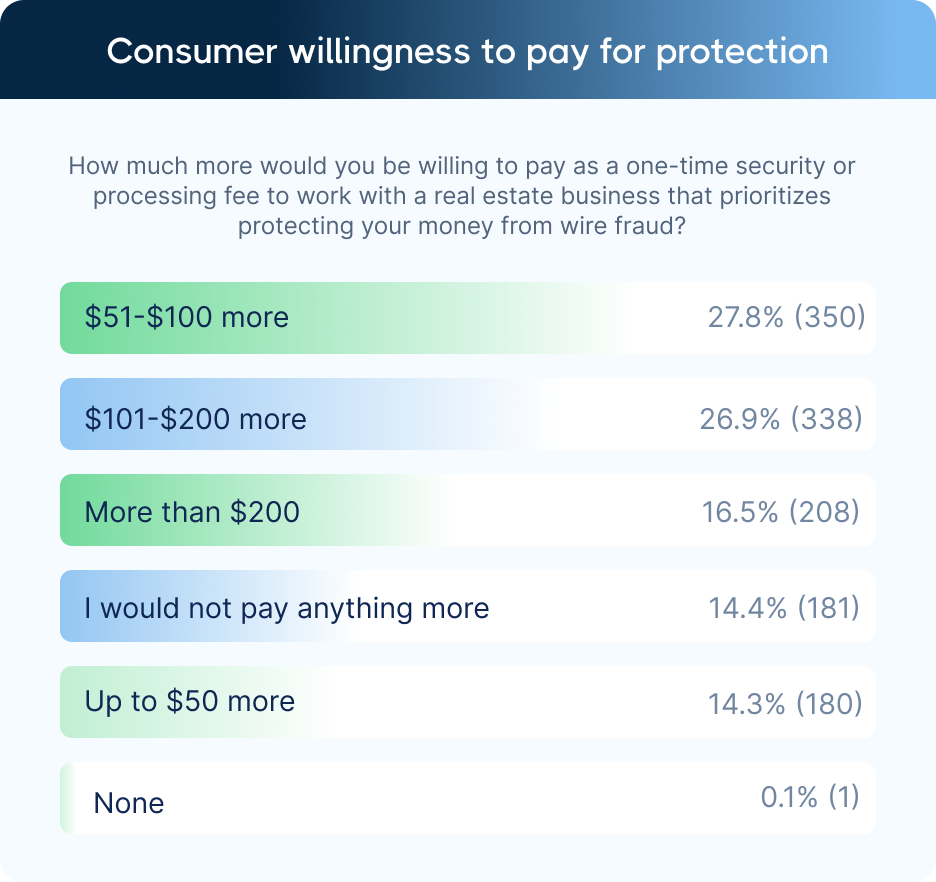
For professionals who have invested in verified protection, this is a competitive advantage that's finally visible to the clients it's meant to serve. For those who haven't, it's a growing gap showing up in how clients choose who to work with.
When fraud happens, the damage doesn’t stop at the money
The financial damage from wire fraud is devastating on its own. But the 2026 report makes clear that the reputational and relational fallout can be just as severe, and far harder to recover from.
56% of consumers said they would not work with a title company or real estate firm again after a wire fraud incident — even if all of their funds were fully recovered.

That’s important. Even when money comes back, trust doesn’t automatically follow.
In an industry built on referrals and long-term relationships, a single fraud event can impact future business in ways that extend far beyond the transaction itself. Lost repeat clients. Damaged referral pipelines. Online reviews. Word-of-mouth.
The liability doesn’t end when the funds are restored.
The tactics are getting smarter — and faster
Wire fraud has always evolved. But the acceleration tied to AI is unlike anything we've seen before.
Criminals are using AI tools to impersonate real estate professionals more accurately. They can mimic email styles, spoof phone numbers, and create fraudulent wire instructions that are nearly indistinguishable from legitimate ones.

Industry data shows a 1,760% increase in business email compromise (BEC) attacks since AI tools became widely available. The volume is extraordinary, and it's not plateauing.
Real estate professionals across the board are also feeling it. 60% of title professionals we surveyed reported that fraud attempts are increasing.
Based on what we're seeing in our own Fraud Recovery Services data, that tracks with what lenders and agents are experiencing, too. The threat is broad and affects buyers, sellers, lenders, and title companies, often targeting them all at once in the same transaction.
What our fraud recovery data reveals about real losses
The 2026 report also draws on CertifID's Fraud Recovery Services (FRS) data to give a clearer picture of what fraud actually looks like when it happens — what types, and how much is at stake.
Three primary fraud categories account for the majority of cases:
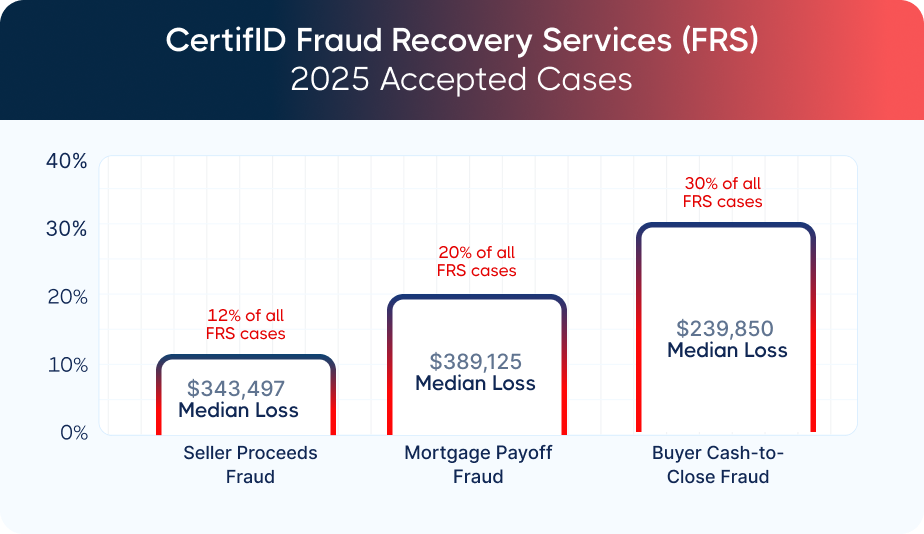
Buyer cash-to-close fraud is the most common, making up 30% of cases. Criminals impersonate title companies and send fraudulent wire instructions to buyers, usually targeting first-timers who are unfamiliar with the process and less likely to question instructions that appear to come from a trusted source. The median loss is $239,850.
Mortgage payoff fraud accounts for 20% of cases and carries the highest median loss of any category: $389,125. Forged payoff statements redirect mortgage funds before the discrepancy is caught, creating direct exposure for lenders processing payoffs and the title companies coordinating them.
Seller net proceeds fraud makes up 12% of cases, with a median loss of $343,497. Criminals impersonate sellers and redirect home sale proceeds to their own accounts, leaving sellers, agents, and title companies scrambling after the fact.
These patterns surface repeatedly in our fraud recovery work, with dollar amounts that underscore how serious the risk is.
The good news: verified prevention works
Here's the other side of the data: when the right protections are in place, they work.
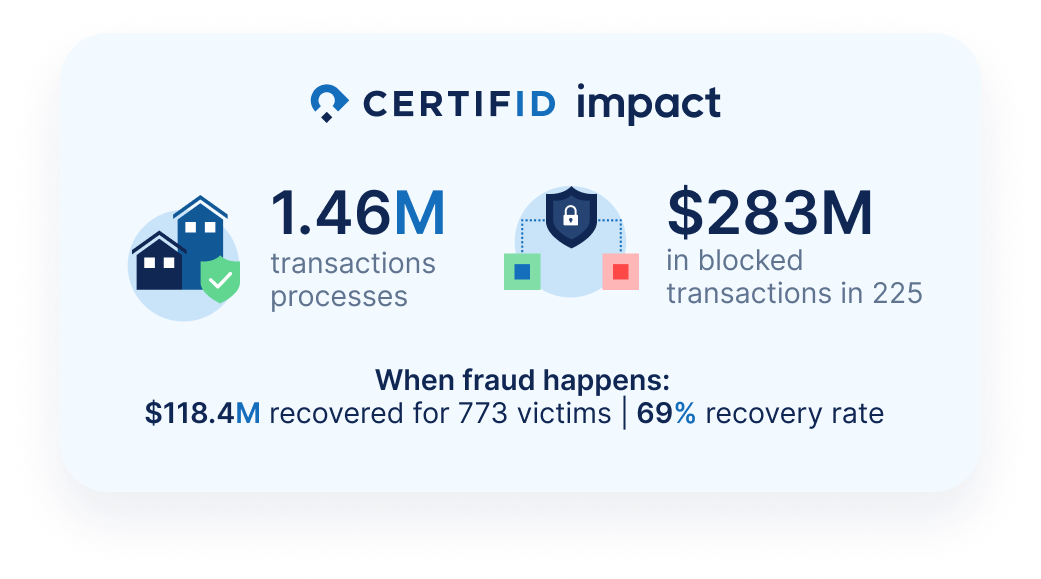
In 2025, CertifID verified more than 1.46 million wire transfers and prevented $283 million in financial loss, blocking 1,018 fraudulent transactions before funds moved. That's not theoretical protection. That's documented, transaction-level defense.
Our Fraud Recovery Services have supported 773 victims and recovered over $118 million in stolen funds, with a 69% recovery rate that is well above the industry average.
Prevention works best when it is applied to every transaction. There's an important distinction between trying to verify and actually verifying. Making a phone call to confirm wire instructions seems like good practice.
However, if the number you call has been spoofed or if the person answering isn’t who you think they are, that call may give you a false sense of security instead of true protection.
In a world where AI can clone voices, replicate email threads, and create fraudulent documents easily, manual processes are both slow and a security risk.
Verified protection means the identity of every party sending or receiving wire instructions has been confirmed through a technology-backed process that criminals can't replicate with a spoofed email or a fake phone number. It means that when funds move, everyone in the transaction can trace exactly who authorized them and why.
That's the difference between hoping nothing goes wrong and knowing you're protected if it does.
Cybercrime isn’t slowing down
Wire fraud in real estate doesn't exist in isolation. It's part of a broader cybercrime crisis. The FBI reported $16.6 billion in total cybercrime losses in 2024, a 33% increase from the prior year. Real estate wire fraud is one of the fastest-growing and most financially damaging categories within that total.
The environment your clients are transacting in has fundamentally changed.
The question isn't whether fraud will be attempted. The question is whether the professionals involved have the infrastructure to stop it.
What this means for everyone in the transaction
The 2026 State of Wire Fraud report is a picture of an industry at an inflection point and a mandate for every professional who touches a real estate transaction.
If you're a title agent or escrow officer: Consumers are choosing closing teams based on protection. The data shows this clearly. Verified wire protection is now table stakes, but firms that can communicate it confidently are still winning on it.
If you're a real estate agent: Your referral relationships are on the line too. When a buyer or seller you referred gets hit by wire fraud, the damage doesn't stop at the closing table. Knowing that your closing partners take verified protection seriously is worth asking about.
If you're a lender: Mortgage payoffs are the highest-loss fraud category in the FRS dataset by the nature of those types of deals. Your exposure in the transaction is real, and so is your clients' trust in the professionals you work alongside.
Different roles. Shared responsibility.
Every transaction deserves verified protection. And the professionals who can confidently stand behind their security measures build something their competitors can't easily match: trust supported by solid infrastructure.
Download the full 2026 State of Wire Fraud Report
This article covers the highlights, but the full report goes deeper. More data, more context, and a closer look at what's driving these trends and what professionals across the industry are doing about it.
It's free and worth the read. The data is there. The question is what you do with it.
FAQ

Content Marketer

Michelle has spent her career in B2B SaaS startups leading content marketing, strategy, and social media efforts that help teams grow and audiences stay informed. At CertifID, she applies that expertise to help title and real estate professionals understand fraud risks and stay ahead of emerging threats.
Every year, we go straight to the source.
We survey consumers and the real estate professionals who serve them — title agents, escrow officers,lenders — to get an honest picture of where wire fraud stands. What are people experiencing? What do they know? What do they expect?
The 2026 State of Wire Fraud report is now available, and the findings are some of the most telling we've seen yet.
If you work anywhere in the real estate transaction, from origination to closing, this data is directly relevant to your business. Here's a breakdown of the key highlights and what they mean for you.
Wire fraud isn’t theoretical anymore
One of the biggest shifts we’ve seen over the years is awareness.
Wire fraud is no longer something only industry insiders talk about. Homebuyers know about it. They’re thinking about it. And it’s influencing how they choose who to work with.
Last year, nearly 1 in 4 homebuyers reportedly received a fraudulent or suspicious communication during their closing last year.
Twenty-two percent of your clients — people in the middle of one of the biggest financial transactions of their lives — reported being targeted. Not hypothetically. Actually.
And here's what makes it even more alarming is that 82% of consumers are already aware that criminals use AI to impersonate real estate professionals.
The days of wire fraud feeling abstract or distant are over. Your clients have heard about this. They've read about it. Some of them have experienced it firsthand.
That awareness is changing behavior in ways that directly impact every professional in the real estate ecosystem.
Security is now part of how consumers choose providers
This is the finding that every real estate professional needs to sit with, whether you're a title agent, a lender, or a real estate agent referring clients to a closing team.
68% of consumers say that guaranteed protection from wire fraud strongly influences which provider they choose.
This isn't just a nice-to-have anymore, but a selection criterion. Consumers are evaluating the firms and professionals they work with through the lens of security, before they sign anything, and before they wire a dollar.
And the willingness to pay for that protection is real. 85% of consumers said they'd pay extra for wire fraud protection from the professionals they work with. Of those, 71% said they'd pay $51 or more.
This is a majority of your market telling you that security has monetary value to them, and that they're willing to factor it into their decisions.
For professionals who have invested in verified protection, this is a competitive advantage that's finally visible to the clients it's meant to serve. For those who haven't, it's a growing gap showing up in how clients choose who to work with.
When fraud happens, the damage doesn’t stop at the money
The financial damage from wire fraud is devastating on its own. But the 2026 report makes clear that the reputational and relational fallout can be just as severe, and far harder to recover from.
56% of consumers said they would not work with a title company or real estate firm again after a wire fraud incident — even if all of their funds were fully recovered.
That’s important. Even when money comes back, trust doesn’t automatically follow.
In an industry built on referrals and long-term relationships, a single fraud event can impact future business in ways that extend far beyond the transaction itself. Lost repeat clients. Damaged referral pipelines. Online reviews. Word-of-mouth.
The liability doesn’t end when the funds are restored.
The tactics are getting smarter — and faster
Wire fraud has always evolved. But the acceleration tied to AI is unlike anything we've seen before.
Criminals are using AI tools to impersonate real estate professionals more accurately. They can mimic email styles, spoof phone numbers, and create fraudulent wire instructions that are nearly indistinguishable from legitimate ones.
Industry data shows a 1,760% increase in business email compromise (BEC) attacks since AI tools became widely available. The volume is extraordinary, and it's not plateauing.
Real estate professionals across the board are also feeling it. 60% of title professionals we surveyed reported that fraud attempts are increasing.
Based on what we're seeing in our own Fraud Recovery Services data, that tracks with what lenders and agents are experiencing, too. The threat is broad and affects buyers, sellers, lenders, and title companies, often targeting them all at once in the same transaction.
What our fraud recovery data reveals about real losses
The 2026 report also draws on CertifID's Fraud Recovery Services (FRS) data to give a clearer picture of what fraud actually looks like when it happens — what types, and how much is at stake.
Three primary fraud categories account for the majority of cases:
Buyer cash-to-close fraud is the most common, making up 30% of cases. Criminals impersonate title companies and send fraudulent wire instructions to buyers, usually targeting first-timers who are unfamiliar with the process and less likely to question instructions that appear to come from a trusted source. The median loss is $239,850.
Mortgage payoff fraud accounts for 20% of cases and carries the highest median loss of any category: $389,125. Forged payoff statements redirect mortgage funds before the discrepancy is caught, creating direct exposure for lenders processing payoffs and the title companies coordinating them.
Seller net proceeds fraud makes up 12% of cases, with a median loss of $343,497. Criminals impersonate sellers and redirect home sale proceeds to their own accounts, leaving sellers, agents, and title companies scrambling after the fact.
These patterns surface repeatedly in our fraud recovery work, with dollar amounts that underscore how serious the risk is.
The good news: verified prevention works
Here's the other side of the data: when the right protections are in place, they work.
In 2025, CertifID verified more than 1.46 million wire transfers and prevented $283 million in financial loss, blocking 1,018 fraudulent transactions before funds moved. That's not theoretical protection. That's documented, transaction-level defense.
Our Fraud Recovery Services have supported 773 victims and recovered over $118 million in stolen funds, with a 69% recovery rate that is well above the industry average.
Prevention works best when it is applied to every transaction. There's an important distinction between trying to verify and actually verifying. Making a phone call to confirm wire instructions seems like good practice.
However, if the number you call has been spoofed or if the person answering isn’t who you think they are, that call may give you a false sense of security instead of true protection.
In a world where AI can clone voices, replicate email threads, and create fraudulent documents easily, manual processes are both slow and a security risk.
Verified protection means the identity of every party sending or receiving wire instructions has been confirmed through a technology-backed process that criminals can't replicate with a spoofed email or a fake phone number. It means that when funds move, everyone in the transaction can trace exactly who authorized them and why.
That's the difference between hoping nothing goes wrong and knowing you're protected if it does.
Cybercrime isn’t slowing down
Wire fraud in real estate doesn't exist in isolation. It's part of a broader cybercrime crisis. The FBI reported $16.6 billion in total cybercrime losses in 2024, a 33% increase from the prior year. Real estate wire fraud is one of the fastest-growing and most financially damaging categories within that total.
The environment your clients are transacting in has fundamentally changed.
The question isn't whether fraud will be attempted. The question is whether the professionals involved have the infrastructure to stop it.
What this means for everyone in the transaction
The 2026 State of Wire Fraud report is a picture of an industry at an inflection point and a mandate for every professional who touches a real estate transaction.
If you're a title agent or escrow officer: Consumers are choosing closing teams based on protection. The data shows this clearly. Verified wire protection is now table stakes, but firms that can communicate it confidently are still winning on it.
If you're a real estate agent: Your referral relationships are on the line too. When a buyer or seller you referred gets hit by wire fraud, the damage doesn't stop at the closing table. Knowing that your closing partners take verified protection seriously is worth asking about.
If you're a lender: Mortgage payoffs are the highest-loss fraud category in the FRS dataset by the nature of those types of deals. Your exposure in the transaction is real, and so is your clients' trust in the professionals you work alongside.
Different roles. Shared responsibility.
Every transaction deserves verified protection. And the professionals who can confidently stand behind their security measures build something their competitors can't easily match: trust supported by solid infrastructure.
Download the full 2026 State of Wire Fraud Report
This article covers the highlights, but the full report goes deeper. More data, more context, and a closer look at what's driving these trends and what professionals across the industry are doing about it.
It's free and worth the read. The data is there. The question is what you do with it.
Content Marketer
Michelle has spent her career in B2B SaaS startups leading content marketing, strategy, and social media efforts that help teams grow and audiences stay informed. At CertifID, she applies that expertise to help title and real estate professionals understand fraud risks and stay ahead of emerging threats.
Sign up for The Wire to join the conversation.






Austin
3601 South Congress Ave.
Ste D200, Austin, Texas 78704

Grand Rapids
124 Fulton Street E
Grand Rapids, MI 49503

