


Vacant land scam: How to spot one and stop it before closing
Here's how that plays out from the moment a fraudster picks a target to the moment they collect a check.
Share article:



Michelle Artreche
5 minutes
Fraud Prevention
Jul 30, 2026
Aug 13, 2026
Quick Summary
Vacant land is one of the easiest properties to steal. There's no mortgage, no one living on it, and often an owner who's out of state and barely thinks about the parcel. A "seller" who only exists on paper can list it and vanish with the proceeds. This guide shows title, escrow, and closing teams how to catch a vacant land scam before you disburse:
- Flagging high-risk vacant-land files at intake
- Verifying the seller's identity independently
- Confirming with the true owner through a channel fraudsters can't control
- Reading the transaction red flags as stop signs
- Making verification a standing policy
Why do fraudsters go after vacant land first?
In 2024, a man phoned a New Jersey real estate agent, Lisa Shaw. He claimed he'd owned a vacant lot in Randolph for 25 years and needed a fast sale to cover his sick wife's medical bills. He didn't own the lot.
The fraud surfaced only after the first $70,000 was paid out. Then the title company hit a snag on a second payment and reached the real owner's son. Cases like this are no longer rare. FBI Newark's Special Agent in Charge, Jim Dennehy, said reports of vacant land fraud have climbed 500% over four years.
This guide covers how the scam works and the checks that stop it at each stage of a file's lifecycle.
Why listen to us
We protected $1.46+ million in real estate transactions in 2025 and blocked over $283 million in attempted fraud. We also purpose-built an identity verification platform to address this exact type of fraud. CertifID is one connected system that runs a seller through more than 150 fraud markers in minutes, and it catches seller impersonation on vacant land specifically.

What is a vacant land scam?
A vacant land scam is a form of seller impersonation fraud.
A fraudster picks a property they have no connection to, poses as the legal owner, lists it, and collects the proceeds at closing. The real owner never agreed to sell. It's the same playbook whether the target is a rural parcel, an empty infill lot, or an out-of-state investment property.
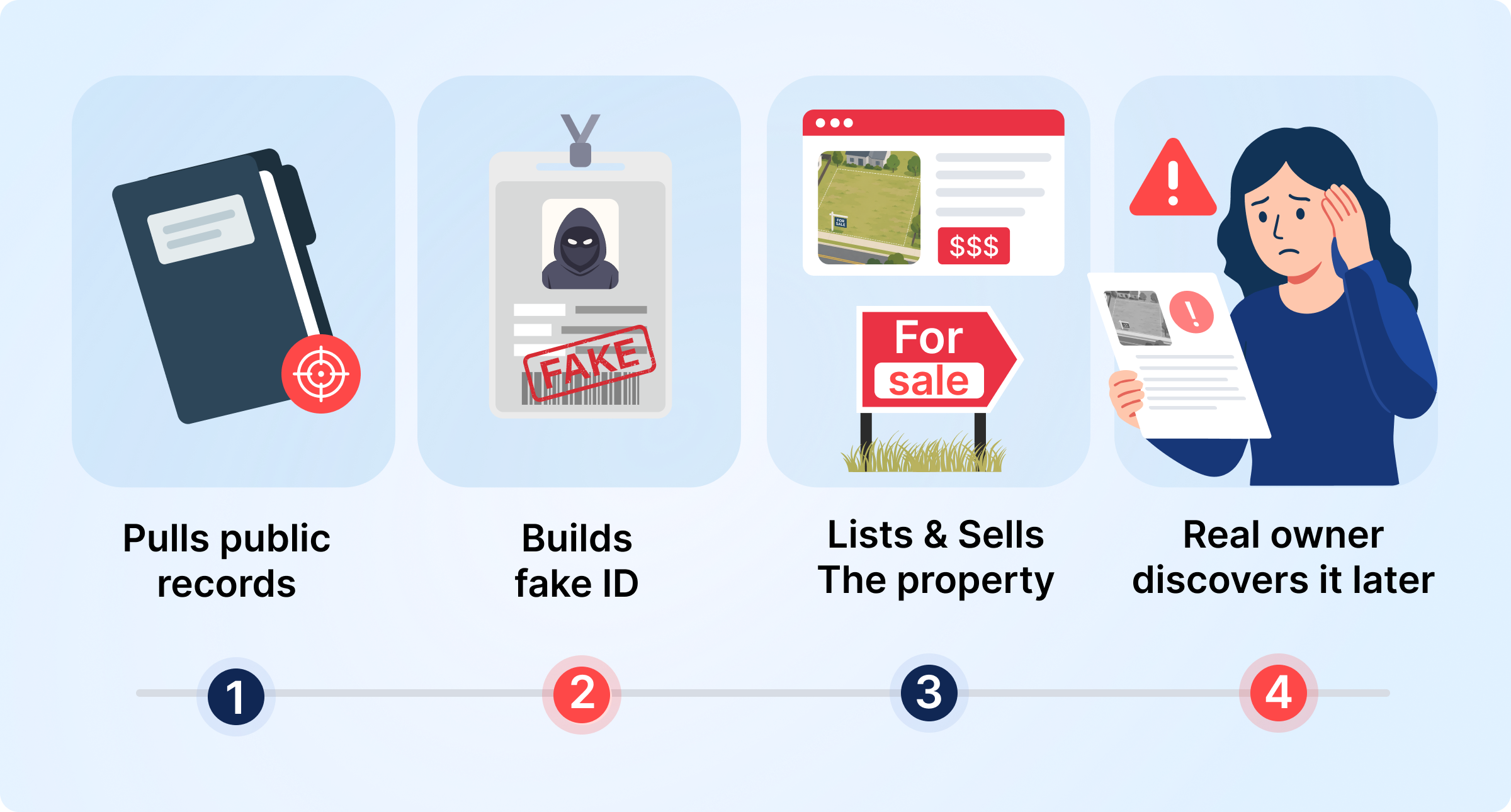
The setup relies on public information, which is what makes it hard to stop with a document check. County records, tax rolls, and assessor databases are open by design. A fraudster can pull the owner's name, mailing address, mortgage status, and whether anyone lives there. They build a counterfeit ID in the owner's name, sometimes using the owner's real Social Security and driver's license numbers, then contact an agent to list the lot.
The fraudulent offer tends to follow a few recurring patterns:
- The property is priced below market value
- All-cash buyer, closing in about three weeks
- Seller refuses to meet in person, citing travel or living abroad
- Seller pushes for a remote or mobile notary they arrange
ALTA found that the most common notarization problems in these cases are fake notary credentials (43%) and stolen real notary credentials used without permission (31%). When one of these closings is concluded, the title company usually absorbs the claim. The buyer inherits a legal fight to keep the property they paid for. The real owner has to prove a transfer that they never signed.
Catching it before funds leave escrow is the only outcome where nobody loses.
How to prevent a vacant land scam
1. Screen every vacant-land file for the target profile at intake
Vacant land fraud screening should begin the moment you open a file, long before anyone sets a closing date.
Start by pulling the county records yourself and looking for a combination of warning signs:
- The parcel is vacant, unimproved, or non-owner-occupied
- No mortgage or lien, so no lender is watching the title
- Owner of record is out of state, an LLC, or inherited the land
- The tax mailing address differs from the property address
- Offer is all-cash, at or below market, with a fast close
One of these details on its own may have a perfectly reasonable explanation. But when two or three appear together, the file deserves more scrutiny. Move it into a high-risk review process, document the reason for the flag, and do not proceed with signing or collecting earnest money until you have verified that the seller is genuinely the owner of record.
One common mistake is assuming that a low-priced rural lot carries less risk because the potential payout is smaller. In reality, these properties can be more attractive to fraudsters precisely because they receive less attention.
A vacant $40,000 parcel may not face the same scrutiny as a $400,000 home, but it should be subject to the same standard of identity verification. Low value should never mean low vigilance.
2. Verify the seller is the real owner, not just that an ID looks valid
This is the step the entire scam depends on, so it needs to be one of the strongest checks in your process.
A scanned driver’s license or notarized document only shows that the paperwork exists. It doesn’t prove the person submitting it is the true owner of the property. Strong verification looks at several independent signals instead of relying on a single document.

CertifID Match combines device verification, multi-factor authentication, and dynamic knowledge-based authentication. The system runs the seller through 150+ fraud markers in minutes. Knowledge-based questions, a past lender, or a prior address trip up a stranger holding a stolen identity.
The process also fits naturally into the title workflow. When the file opens, the title company or listing agent sends the seller a verification request through the platform. CertifID assesses the risk and, when something looks suspicious, asks for additional proof of ownership before the transaction can move forward.
Verified seller transactions also carry up to $5 million in insurance per transaction. For title companies and real estate law firms, the verification result stays in the file as a clear record of the checks completed. That documentation can be especially valuable if someone later challenges the transaction.
Two common mistakes can undermine the entire process:
- The first is verifying the buyer and their funds thoroughly while never independently confirming the seller’s identity, which means the person committing the fraud can end up with the least scrutiny of anyone in the file.
- The second is letting the seller choose or control their own verification or notary process. ALTA flags that kind of resistance as a major warning sign. A legitimate seller should usually be able to complete a standard identity check without difficulty.
3. Reach the true owner through the contact information you sourced yourself
Independent contact is one of the oldest fraud controls, but it still works because it moves the conversation outside the channel the fraudster controls. Send a confirmation letter by regular USPS mail to the owner’s address listed in the county records, never the address the supposed seller provides. Ask whoever receives it to call your office and confirm that they are selling the property.
You can also call the owner directly, but find the phone number independently. Do not simply use the number listed on the seller’s paperwork. Most importantly, make contact before the closing or any money changes hands.
The logic is simple. A letter to the record owner's real address either reaches the genuine owner or someone who never listed the property. Either way, you learn what you need. A fraudster at a different address never receives it.
The Randolph case shows what happens when this check comes last. The fraud only surfaced when a second $70,000 payment hit a snag, and the title company finally reached the real owner's son. By then, the first $70,000 was gone. The same call at intake would have killed the deal before a dollar moved.
4. Control the closing and notarization instead of letting the seller run it
Notarization can become the weak point in the process, because a stamp looks official even when it’s fake. As many as 43% of seller impersonation cases involve fraudulent notary credentials, and another 31% involve credentials stolen from a real notary.
The pattern is often the same. The supposed seller refuses to sign in person, insists on using a remote notary they selected, and then submits falsified documents that appear legitimate at first glance.
The safest approach is to remove that choice from the seller entirely. Don’t accept a seller-selected notary, an unrecorded remote signing, or a notary stamp without independently checking it. Your team should choose the notary or signing agent and control the process from start to finish.
For remote signings, use a proper remote online notarization platform that includes credential analysis, biometric or liveness checks, and a recorded session. This forces the seller to verify their identity live rather than simply sending over a stamped PDF.
A determined fraudster may be able to forge a document, but passing a live identity check on camera is much harder. Your team should also verify the notary’s commission directly through the relevant state database before any funds are released.
The rule is simple: if your team didn’t arrange the signing, don’t automatically trust it. And if a seller resists your chosen notary or remote notarization process, treat that as a reason to pause the file and investigate further.
5. Put it in writing, and know what to do if you catch one
The most common failure is a process that lives in one person's head. One skipped check on a busy Friday is all it takes. Document identity verification, independent owner contact, and controlled notarization as mandatory steps in every vacant-land file.
Train the whole team on the red flags. ALTA's recommended controls start with staff training and clear signing-agent rules. Document each check as you go, so the file itself proves the work was done. When verification is built into the workflow for every vacant-land order, it stops depending on whether a specific closer remembered.
Set the response protocol before you need it:
- Stop the transaction immediately if you suspect fraud
- Report it to the FBI's IC3
- Notify your underwriter
- Contact the receiving bank at once to attempt a recall if funds have already been moved
Speed decides everything. Payoff fraud recovery is far more likely in the first hours than the first days.
A rural Georgia county sheriff investigated at least seven fraudulent vacant-property listings over two months in 2024. He noticed that the same fraudsters were working multiple agents and offices at once. If one file in your area shows the pattern, the next may already be in your pipeline. Our guide on how title agents can prevent real estate fraud goes into greater depth.
Close the two vulnerabilities that the vacant land scam depends on
A vacant land scam exploits two weaknesses in a closing workflow:
- No one proves the seller is really the owner.
- Nobody validates the payout account before funds go out.
Every step above closes one of those openings. Screen the file. Verify the seller against the owner of the record. Reach the true owner independently. Control the notarization and validate the destination account. Make sure funds leave escrow only after every party has been verified.
If you want those checks built into your closing workflow instead of living on a checklist someone has to remember, book a demo with CertifID. You'll get seller identity verification for exactly this type of fraud, plus direct insurance coverage of up to $5 million per file. It costs far less than a single fraud claim would.

FAQ
Why do scammers target vacant land specifically?

No mortgage means no lender watching the title. Owners are often out of state, or have inherited the parcel and don't check on it. No tenant or neighbor notices a listing. That mix of high equity and low attention is ideal for a fraudster.
What are the biggest red flags of a vacant land scam?
A seller who won't meet in person, prices below market, and pushes for a fast, all-cash close. Add an inability to produce the APN, deed, or recent tax bill; a mismatched mailing address; insistence on their own notary; or a request to send proceeds to a new or out-of-state account. Any combination is worth a hard pause.
How do fraudsters fake the notarization?
Three ways: counterfeit notary stamps built from public information, stolen credentials from a real notary, or simply false claims of being commissioned. ALTA found 43% of cases involve fake credentials and 31% involve stolen ones. Controlling notary selection and verifying the commission yourself matters as much as checking the ID.
Who is liable when a vacant land sale turns out to be fraudulent?
The title company or closing agent usually absorbs the claim. The buyer is left fighting to keep the property they paid for. The real owner has to prove an unauthorized transfer. Everyone loses time and money, which is why catching it before closing matters more than unwinding it after.
Can you get the money back after a vacant land scam?
Sometimes, but only if you move fast. Recovery odds are highest in the first hours, while funds may still be frozen before they're moved offshore. File a complaint with the FBI IC3 and the receiving bank immediately, and bring in a recovery team that knows the process. Once the money leaves the country, there's no guarantee.

Content Marketer

Michelle has spent her career in B2B SaaS startups leading content marketing, strategy, and social media efforts that help teams grow and audiences stay informed. At CertifID, she applies that expertise to help title and real estate professionals understand fraud risks and stay ahead of emerging threats.
Quick Summary
Vacant land is one of the easiest properties to steal. There's no mortgage, no one living on it, and often an owner who's out of state and barely thinks about the parcel. A "seller" who only exists on paper can list it and vanish with the proceeds. This guide shows title, escrow, and closing teams how to catch a vacant land scam before you disburse:
- Flagging high-risk vacant-land files at intake
- Verifying the seller's identity independently
- Confirming with the true owner through a channel fraudsters can't control
- Reading the transaction red flags as stop signs
- Making verification a standing policy
Why do fraudsters go after vacant land first?
In 2024, a man phoned a New Jersey real estate agent, Lisa Shaw. He claimed he'd owned a vacant lot in Randolph for 25 years and needed a fast sale to cover his sick wife's medical bills. He didn't own the lot.
The fraud surfaced only after the first $70,000 was paid out. Then the title company hit a snag on a second payment and reached the real owner's son. Cases like this are no longer rare. FBI Newark's Special Agent in Charge, Jim Dennehy, said reports of vacant land fraud have climbed 500% over four years.
This guide covers how the scam works and the checks that stop it at each stage of a file's lifecycle.
Why listen to us
We protected $1.46+ million in real estate transactions in 2025 and blocked over $283 million in attempted fraud. We also purpose-built an identity verification platform to address this exact type of fraud. CertifID is one connected system that runs a seller through more than 150 fraud markers in minutes, and it catches seller impersonation on vacant land specifically.
What is a vacant land scam?
A vacant land scam is a form of seller impersonation fraud.
A fraudster picks a property they have no connection to, poses as the legal owner, lists it, and collects the proceeds at closing. The real owner never agreed to sell. It's the same playbook whether the target is a rural parcel, an empty infill lot, or an out-of-state investment property.
The setup relies on public information, which is what makes it hard to stop with a document check. County records, tax rolls, and assessor databases are open by design. A fraudster can pull the owner's name, mailing address, mortgage status, and whether anyone lives there. They build a counterfeit ID in the owner's name, sometimes using the owner's real Social Security and driver's license numbers, then contact an agent to list the lot.
The fraudulent offer tends to follow a few recurring patterns:
- The property is priced below market value
- All-cash buyer, closing in about three weeks
- Seller refuses to meet in person, citing travel or living abroad
- Seller pushes for a remote or mobile notary they arrange
ALTA found that the most common notarization problems in these cases are fake notary credentials (43%) and stolen real notary credentials used without permission (31%). When one of these closings is concluded, the title company usually absorbs the claim. The buyer inherits a legal fight to keep the property they paid for. The real owner has to prove a transfer that they never signed.
Catching it before funds leave escrow is the only outcome where nobody loses.
How to prevent a vacant land scam
1. Screen every vacant-land file for the target profile at intake
Vacant land fraud screening should begin the moment you open a file, long before anyone sets a closing date.
Start by pulling the county records yourself and looking for a combination of warning signs:
- The parcel is vacant, unimproved, or non-owner-occupied
- No mortgage or lien, so no lender is watching the title
- Owner of record is out of state, an LLC, or inherited the land
- The tax mailing address differs from the property address
- Offer is all-cash, at or below market, with a fast close
One of these details on its own may have a perfectly reasonable explanation. But when two or three appear together, the file deserves more scrutiny. Move it into a high-risk review process, document the reason for the flag, and do not proceed with signing or collecting earnest money until you have verified that the seller is genuinely the owner of record.
One common mistake is assuming that a low-priced rural lot carries less risk because the potential payout is smaller. In reality, these properties can be more attractive to fraudsters precisely because they receive less attention.
A vacant $40,000 parcel may not face the same scrutiny as a $400,000 home, but it should be subject to the same standard of identity verification. Low value should never mean low vigilance.
2. Verify the seller is the real owner, not just that an ID looks valid
This is the step the entire scam depends on, so it needs to be one of the strongest checks in your process.
A scanned driver’s license or notarized document only shows that the paperwork exists. It doesn’t prove the person submitting it is the true owner of the property. Strong verification looks at several independent signals instead of relying on a single document.
CertifID Match combines device verification, multi-factor authentication, and dynamic knowledge-based authentication. The system runs the seller through 150+ fraud markers in minutes. Knowledge-based questions, a past lender, or a prior address trip up a stranger holding a stolen identity.
The process also fits naturally into the title workflow. When the file opens, the title company or listing agent sends the seller a verification request through the platform. CertifID assesses the risk and, when something looks suspicious, asks for additional proof of ownership before the transaction can move forward.
Verified seller transactions also carry up to $5 million in insurance per transaction. For title companies and real estate law firms, the verification result stays in the file as a clear record of the checks completed. That documentation can be especially valuable if someone later challenges the transaction.
Two common mistakes can undermine the entire process:
- The first is verifying the buyer and their funds thoroughly while never independently confirming the seller’s identity, which means the person committing the fraud can end up with the least scrutiny of anyone in the file.
- The second is letting the seller choose or control their own verification or notary process. ALTA flags that kind of resistance as a major warning sign. A legitimate seller should usually be able to complete a standard identity check without difficulty.
3. Reach the true owner through the contact information you sourced yourself
Independent contact is one of the oldest fraud controls, but it still works because it moves the conversation outside the channel the fraudster controls. Send a confirmation letter by regular USPS mail to the owner’s address listed in the county records, never the address the supposed seller provides. Ask whoever receives it to call your office and confirm that they are selling the property.
You can also call the owner directly, but find the phone number independently. Do not simply use the number listed on the seller’s paperwork. Most importantly, make contact before the closing or any money changes hands.
The logic is simple. A letter to the record owner's real address either reaches the genuine owner or someone who never listed the property. Either way, you learn what you need. A fraudster at a different address never receives it.
The Randolph case shows what happens when this check comes last. The fraud only surfaced when a second $70,000 payment hit a snag, and the title company finally reached the real owner's son. By then, the first $70,000 was gone. The same call at intake would have killed the deal before a dollar moved.
4. Control the closing and notarization instead of letting the seller run it
Notarization can become the weak point in the process, because a stamp looks official even when it’s fake. As many as 43% of seller impersonation cases involve fraudulent notary credentials, and another 31% involve credentials stolen from a real notary.
The pattern is often the same. The supposed seller refuses to sign in person, insists on using a remote notary they selected, and then submits falsified documents that appear legitimate at first glance.
The safest approach is to remove that choice from the seller entirely. Don’t accept a seller-selected notary, an unrecorded remote signing, or a notary stamp without independently checking it. Your team should choose the notary or signing agent and control the process from start to finish.
For remote signings, use a proper remote online notarization platform that includes credential analysis, biometric or liveness checks, and a recorded session. This forces the seller to verify their identity live rather than simply sending over a stamped PDF.
A determined fraudster may be able to forge a document, but passing a live identity check on camera is much harder. Your team should also verify the notary’s commission directly through the relevant state database before any funds are released.
The rule is simple: if your team didn’t arrange the signing, don’t automatically trust it. And if a seller resists your chosen notary or remote notarization process, treat that as a reason to pause the file and investigate further.
5. Put it in writing, and know what to do if you catch one
The most common failure is a process that lives in one person's head. One skipped check on a busy Friday is all it takes. Document identity verification, independent owner contact, and controlled notarization as mandatory steps in every vacant-land file.
Train the whole team on the red flags. ALTA's recommended controls start with staff training and clear signing-agent rules. Document each check as you go, so the file itself proves the work was done. When verification is built into the workflow for every vacant-land order, it stops depending on whether a specific closer remembered.
Set the response protocol before you need it:
- Stop the transaction immediately if you suspect fraud
- Report it to the FBI's IC3
- Notify your underwriter
- Contact the receiving bank at once to attempt a recall if funds have already been moved
Speed decides everything. Payoff fraud recovery is far more likely in the first hours than the first days.
A rural Georgia county sheriff investigated at least seven fraudulent vacant-property listings over two months in 2024. He noticed that the same fraudsters were working multiple agents and offices at once. If one file in your area shows the pattern, the next may already be in your pipeline. Our guide on how title agents can prevent real estate fraud goes into greater depth.
Close the two vulnerabilities that the vacant land scam depends on
A vacant land scam exploits two weaknesses in a closing workflow:
- No one proves the seller is really the owner.
- Nobody validates the payout account before funds go out.
Every step above closes one of those openings. Screen the file. Verify the seller against the owner of the record. Reach the true owner independently. Control the notarization and validate the destination account. Make sure funds leave escrow only after every party has been verified.
If you want those checks built into your closing workflow instead of living on a checklist someone has to remember, book a demo with CertifID. You'll get seller identity verification for exactly this type of fraud, plus direct insurance coverage of up to $5 million per file. It costs far less than a single fraud claim would.
Content Marketer
Michelle has spent her career in B2B SaaS startups leading content marketing, strategy, and social media efforts that help teams grow and audiences stay informed. At CertifID, she applies that expertise to help title and real estate professionals understand fraud risks and stay ahead of emerging threats.
Sign up for The Wire to join the conversation.



.png)


Austin
3601 South Congress Ave.
Ste D200, Austin, Texas 78704

Grand Rapids
124 Fulton Street E
Grand Rapids, MI 49503

