


6 types of real estate fraud and how to prevent them
Each of the six below follows its own pattern. They target different parties, show up at different points in the closing, and get caught by different controls. Here's what to look for.
Share article:



Michelle Artreche
5 minutes
Fraud Prevention
Sep 2, 2026
Sep 2, 2026
Quick summary
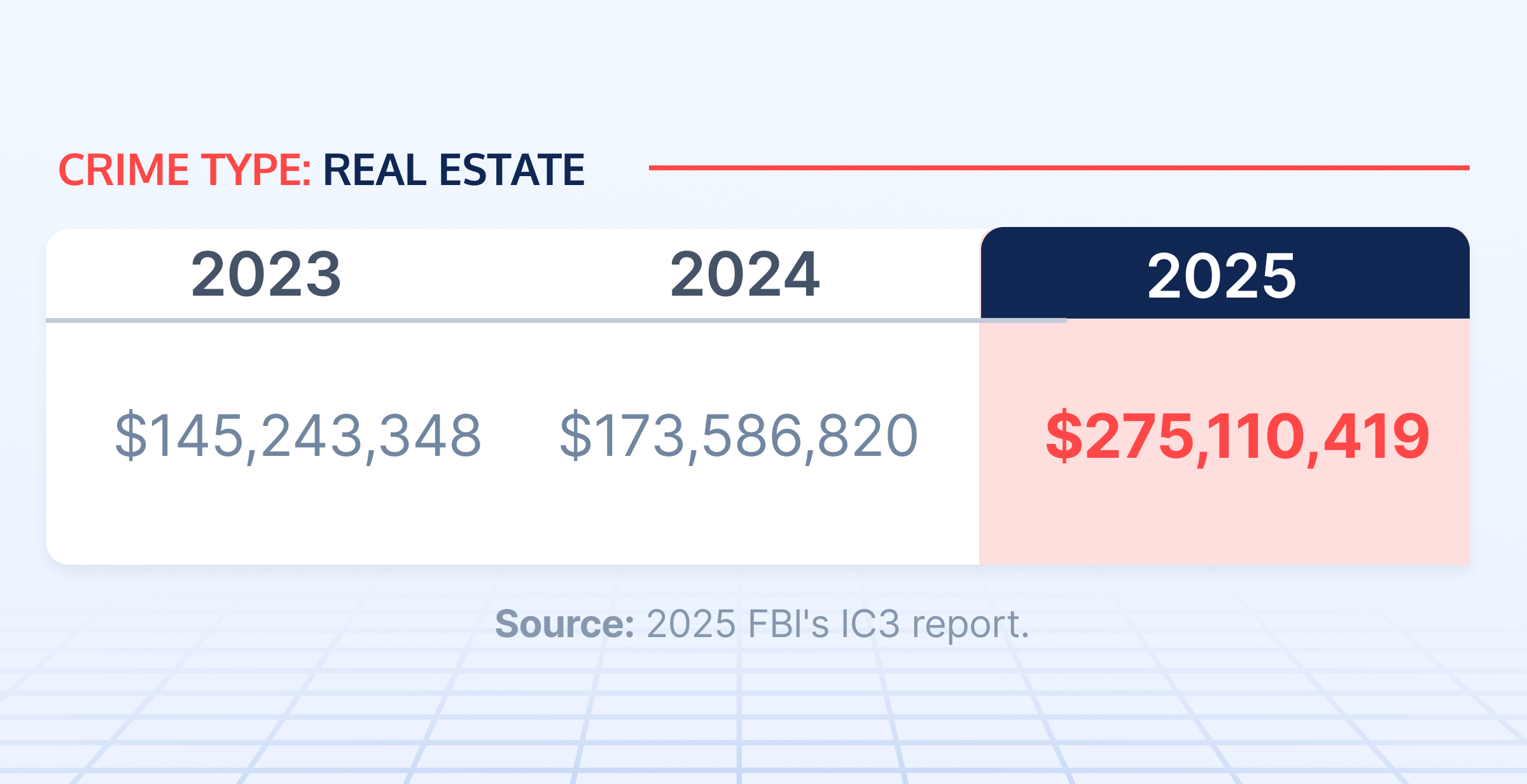
Real estate fraud cost American victims $275.1 million in 2025, up 59% from the year before. The six most common types are business email compromise (BEC), seller impersonation, payoff fraud, deed theft, rental scams, and foreclosure rescue schemes. Each one follows a distinct pattern with warning signs you can spot.
Real estate fraud works because closings are built on trust
People trust their title company, their lender, and their real estate agent. In a normal closing, they should. But fraudsters exploit that trust at the exact moment it matters most, when hundreds of thousands of dollars are about to be wired.
The FBI's IC3 logged $275.1 million in real estate losses in 2025. That's up 59% from $173.6 million the year before. Note that those numbers only capture what's reported, because many victims don't file for weeks, and some never file at all.
A phishing email that steals a $50 gift card is a nuisance. But a spoofed wire that redirects a $300,000 down payment can wipe out a family's savings. All six follow a distinct pattern, and all six are preventable.
Why listen to us?
Every fraud type here comes from patterns we've seen firsthand. CertifID has verified identities across 1.46 million real estate transactions in 2025 and blocked $283 million in attempted fraud across 1,018 blocked transactions in 2025. Our fraud recovery team supported 870+ victims and recovered $140+ million, alongside banks and the U.S. Secret Service.
We publish the annual State of Wire Fraud Report, cited by ALTA and NAR. The 2026 edition found that 22% of homebuyers received fraudulent communications during their closing.
What is real estate fraud?
Real estate fraud is any scheme that uses deception to steal money or property during a closing. It can target buyers, sellers, title companies, lenders, or attorneys. Some schemes are high-tech, like a hacker intercepting email threads. Others are old-fashioned, like forging a deed to steal a vacant property.
Fraudsters exploit trust and time pressure across all of them. Down payments, payoffs, and earnest money are all wired between parties in a tight window. A single weak point can cost someone their life savings.
Why is real estate fraud important to understand?
The losses are growing fast, and they're not just hitting buyers. Title companies, lenders, and law firms all sit in the blast radius, because every party in a closing touches the money at some point.
You'd think E&O policies or cyber riders would cover these losses, but they usually don't. Title professionals find this out the hard way, after a six-figure loss. On top of that, fraudsters are using AI to write convincing emails, clone voices for callbacks, and create fake IDs that pass basic visual checks. BEC attacks alone surged 1,760% since generative AI tools became widely available, and those attacks keep getting more sophisticated.
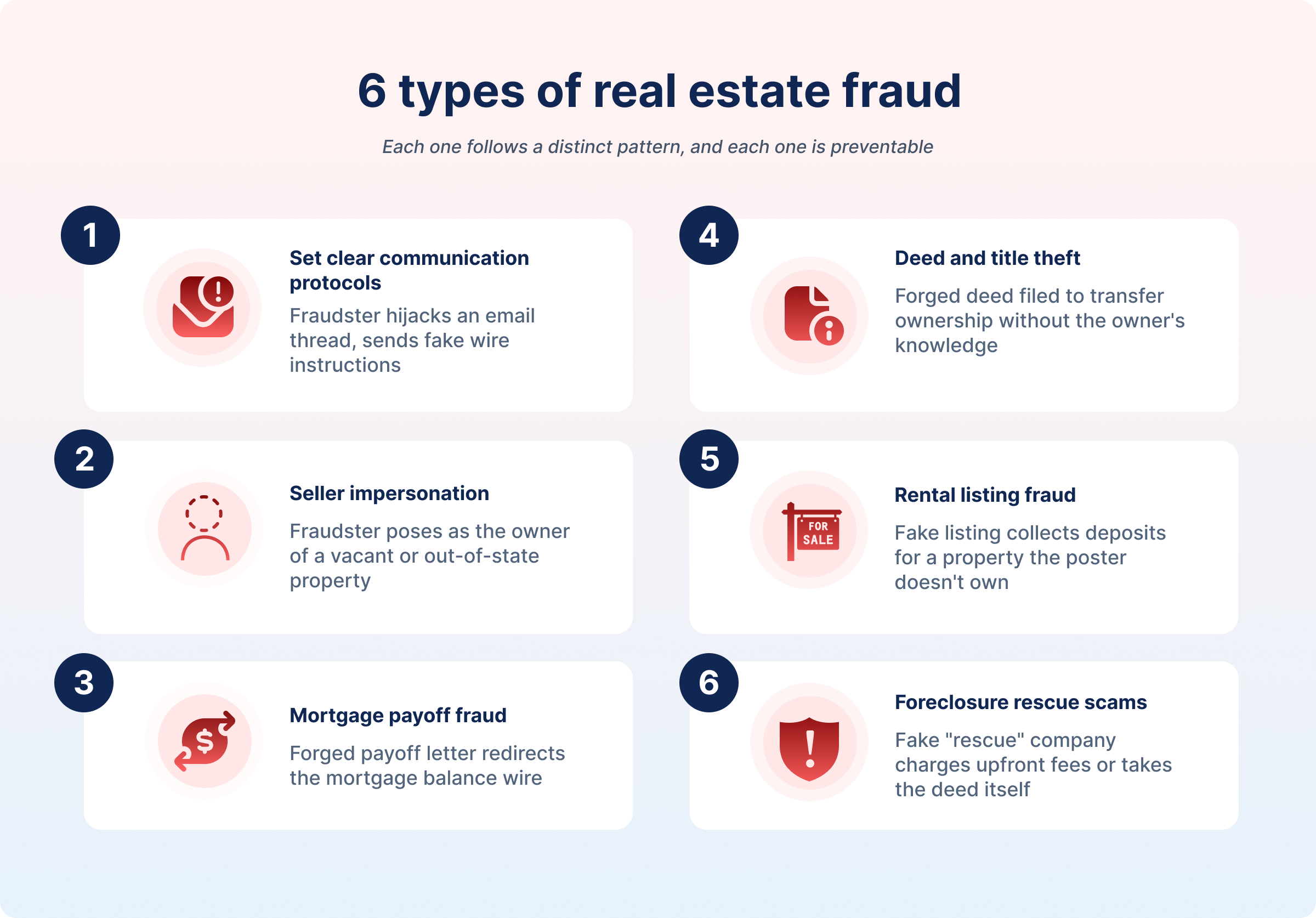
6 types of real estate fraud
1. Payment fraud through business email compromise (BEC)
This is the most expensive type of real estate payment fraud. A fraudster gains access to an email account belonging to an agent, title company, lender, or buyer. They'll monitor the thread until closing day, then send altered wiring instructions that look identical to the legitimate ones.
BEC cost $2.77 billion in 2024 across all industries, and the FBI calls real estate one of the hardest-hit sectors.
Down payments and payoffs are coordinated by email, so one compromised thread can redirect a six-figure wire. Once funds reach the wrong account, they can be transferred overseas within hours.
Warning signs. Last-minute changes to wiring instructions. Email addresses with subtle misspellings, like one extra letter or a switched domain. Pressure to wire immediately with no verification through a second channel.
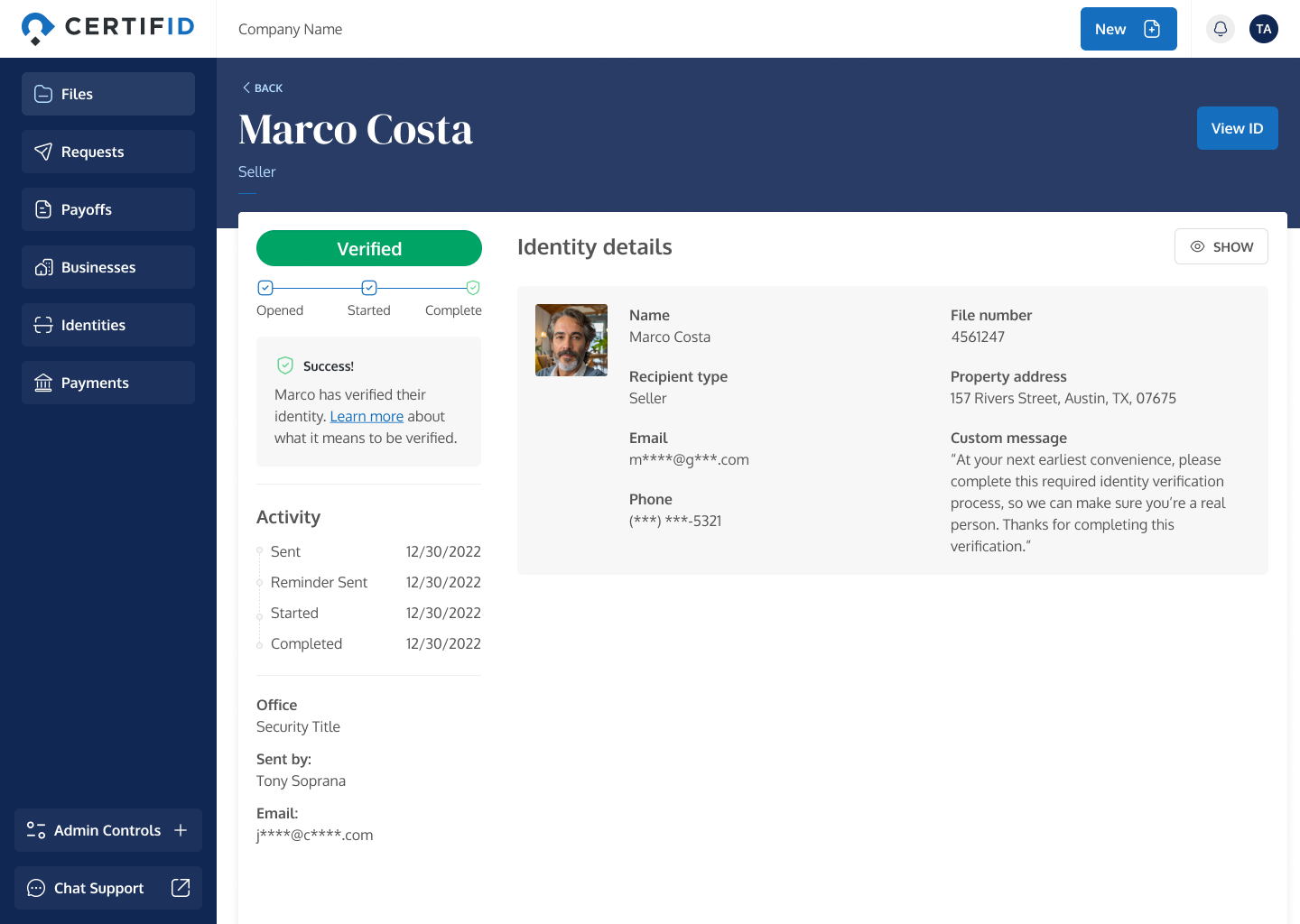
How to prevent it. Verify the identity of every party before you release funds. Confirm wiring details through a separate channel, and call a number from the title company's own website. CertifID automates this by running every identity through 150 fraud markers. Every verified wire is backed by up to $5 million in direct insurance.
2. Seller impersonation fraud
A fraudster pretends to be the owner of a property and lists it for sale. They usually target vacant lots or homes where the real owner lives out of state, because nobody's around to notice. They'll forge IDs and push to close fast, before anyone verifies who they're dealing with. These schemes work because nobody's watching the property, and vacant lots have fewer encumbrances for a title search to flag.
Warning signs. A seller who insists on handling everything remotely and won't meet in person. A vacant or rural property with an out-of-state owner. Identification documents that look slightly off on close inspection, and a seller who's eager to close fast at below-market prices.
How to prevent it. Verify the seller's identity through multiple channels beyond the documents they provide. Cross-reference property records with county tax rolls and require notarized documents with in-person or secure remote notarization. Some title companies now require identity verification for sellers on every file.
3. Mortgage payoff fraud
In this scheme, a fraudster intercepts or forges a mortgage payoff statement. The title company receives what looks like a legitimate payoff letter, but the account number or routing information has been changed. When the payoff wire goes out, it goes to the fraudster's account.
This type's especially dangerous because payoff wires are routine. Title companies send them constantly, often to the same lenders, so they stop checking the details as carefully. One title company found out the hard way. In August 2024, an employee at Sarah Dombrowski's Unique Title and Escrow discovered a $311,785 mortgage payoff wire had never reached its destination, redirected mid-transaction by a fraudster. "It's like hitting a Mack truck at 60 miles per hour," Dombrowski says. Her team recovered most of the funds through CertifID's Fraud Recovery Services, but the experience changed how her company verifies every wire.
Mortgage payoff fraud was the most damaging category in 2025, accounting for 20% of all Fraud Recovery Services cases with a median loss of $389,125. That's because payoffs represent the full remaining balance on a mortgage.
Warning signs. A payoff statement with different wiring instructions than prior payoffs from the same lender. Changes that arrive close to the closing, or a payoff from a lender you haven't worked with before. Instructions from a personal email address are another red flag.
How to prevent it. Verify every payoff independently before sending funds, even with familiar lenders. CertifID's PayoffProtect automates this by verifying payoff authenticity in real time. 97% of payoffs are verified instantly. Every verified payoff is backed by direct insurance.
4. Deed and title theft
Also known as deed fraud, this happens when someone forges a deed to transfer property ownership without the owner's knowledge. A fraudster might file a fake quitclaim deed with the county recorder, then sell the property or borrow against it. It's most common with vacant properties, elderly homeowners, and owners who live out of state.
Warning signs. Unfamiliar documents or charges on your property title, or unexpected mortgage statements and tax bills. A title search that reveals unauthorized liens or transfers is another sign. You might also start getting mail from mortgage companies you've never worked with.
How to prevent it. Monitor your property records through your county recorder's website. Many counties offer free title monitoring services that alert you to new filings. Consider title lock services for high-value or vacant properties. If you're a title company, flag any recent quitclaim deeds that don't match the expected chain of ownership.
5. Rental listing fraud
Fraudsters create fake listings for properties they don't own, collect application fees or security deposits, and disappear. They'll scrape legitimate listings, copy the photos, and repost them at a lower price.
The FTC reports that consumers lost $65 million to 65,000 rental scams between 2020 and 2024. Fake listings spread easily on platforms where anyone can post, and they target renters who feel pressure to lock down a unit fast.
Warning signs. A rental price that's significantly below market rate. A landlord who asks for payment via wire transfer or gift cards before you've seen the unit. Photos that show up in other ads, and a landlord who can't meet in person.
How to prevent it. Always see a property in person before sending money. Verify ownership records through the county assessor's office, and never send deposits via wire transfer or gift card. Use established rental platforms that verify landlord identities.
6. Foreclosure rescue scams
These schemes target homeowners who are behind on payments or facing foreclosure. The fraudster poses as a "rescue" company, promising to negotiate with the lender, but they'll require large upfront fees first. In some cases, they'll convince the homeowner to sign over the deed entirely.
The FTC and state attorneys general have prosecuted numerous foreclosure rescue operations. Some operate as fake law firms or "housing counselors," while others simply collect fees and do nothing. HUD-approved counseling agencies provide these services for free, so anyone charging large upfront fees is likely running a scam.
Warning signs. Unsolicited contact from a company that promises to "save" your home. Demands for large upfront fees before any work's done. Pressure to sign documents you don't fully understand, instructions to stop making mortgage payments, or any request to sign over your deed.
How to prevent it. Contact your lender directly if you're struggling with payments. Work with a HUD-approved housing counselor through the Consumer Financial Protection Bureau. Don't sign over your deed to anyone promising foreclosure rescue, and report suspicious companies to your state's attorney general.
Take fraud seriously before it costs you
Real estate fraud isn't slowing down. Losses grew 59% from 2024 to 2025, and fraudsters are using AI to get even better. But every type of fraud comes back to the same failure. Someone skipped a verification step, and funds ended up in the wrong account.
That's the part you can control. Whether you're a buyer wiring a down payment or a title company releasing a payoff, the fix is the same. Verify every identity and every set of wiring instructions before funds leave the account.
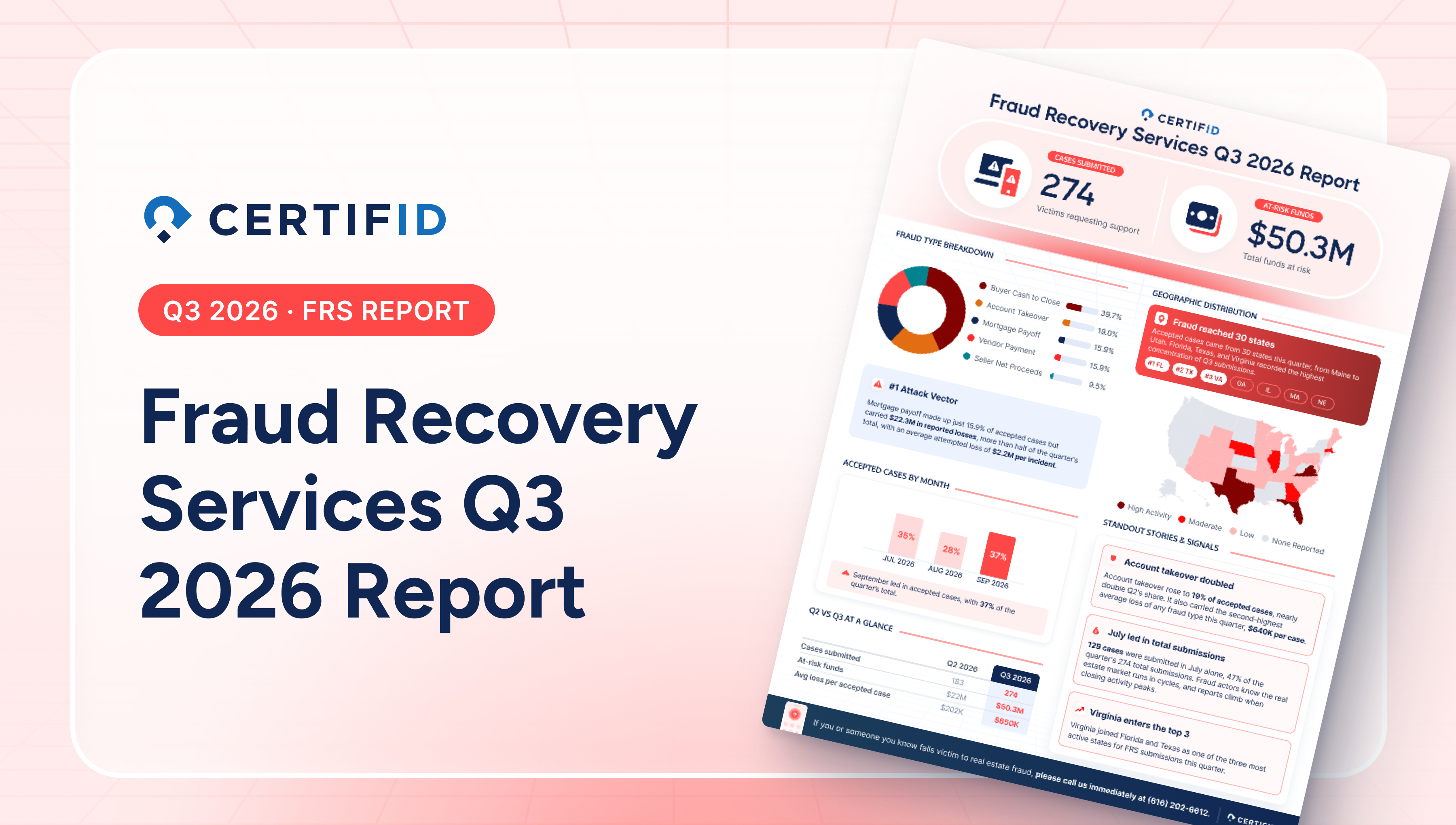
At CertifID, we've built verification into the closing workflow so nothing gets skipped. And if something does go wrong, our Fraud Recovery Services team has supported 870+ victims through the recovery process, helping recover more than $140 million in stolen funds. That support goes beyond the financial recovery itself, with our team guiding victims through an incredibly stressful and emotional situation from start to finish. Request a demo to see how it works in your closings.

FAQ
What type of real estate fraud is most common?

Payment fraud through BEC is the most common and most expensive form. BEC cost $2.77 billion across all industries in 2024. Real estate is a top target because down payments and payoffs are wired on tight deadlines.
Can you get your money back after real estate fraud?
It's possible, but it depends on how fast you act. The first 24 to 48 hours are critical, because banks can often freeze funds before they're transferred offshore. Contact your bank immediately and file a report with the FBI's IC3. CertifID's fraud recovery team has recovered $140+ million for 870+ victims.
Does homeowners insurance cover real estate fraud?
Most homeowners insurance policies don't cover payment fraud or social engineering losses, and standard E&O policies and cyber riders typically exclude them, too. Direct fraud insurance, like the $5 million-per-file coverage CertifID provides, covers what traditional policies don't.
How do I protect myself from real estate payment fraud?
Verify wiring instructions through at least two independent channels before sending any funds. Confirm the identity of everyone involved and ask your title company what fraud prevention tools they use, and whether those include insurance backing. The 2026 State of Wire Fraud Report found that 85% of homebuyers would pay extra for that protection.
What should I do if I suspect real estate fraud?
Act immediately. Contact your bank and ask them to recall the wire. File a report with the FBI's IC3 within 24 hours. Notify your title company, real estate agent, and lender. For deed fraud, contact your county recorder's office and consult a real estate attorney. The faster you report it, the better your chances.

Content Marketer

Michelle has spent her career in B2B SaaS startups leading content marketing, strategy, and social media efforts that help teams grow and audiences stay informed. At CertifID, she applies that expertise to help title and real estate professionals understand fraud risks and stay ahead of emerging threats.
Quick summary
Real estate fraud cost American victims $275.1 million in 2025, up 59% from the year before. The six most common types are business email compromise (BEC), seller impersonation, payoff fraud, deed theft, rental scams, and foreclosure rescue schemes. Each one follows a distinct pattern with warning signs you can spot.
Real estate fraud works because closings are built on trust
People trust their title company, their lender, and their real estate agent. In a normal closing, they should. But fraudsters exploit that trust at the exact moment it matters most, when hundreds of thousands of dollars are about to be wired.
The FBI's IC3 logged $275.1 million in real estate losses in 2025. That's up 59% from $173.6 million the year before. Note that those numbers only capture what's reported, because many victims don't file for weeks, and some never file at all.
A phishing email that steals a $50 gift card is a nuisance. But a spoofed wire that redirects a $300,000 down payment can wipe out a family's savings. All six follow a distinct pattern, and all six are preventable.
Why listen to us?
Every fraud type here comes from patterns we've seen firsthand. CertifID has verified identities across 1.46 million real estate transactions in 2025 and blocked $283 million in attempted fraud across 1,018 blocked transactions in 2025. Our fraud recovery team supported 870+ victims and recovered $140+ million, alongside banks and the U.S. Secret Service.
We publish the annual State of Wire Fraud Report, cited by ALTA and NAR. The 2026 edition found that 22% of homebuyers received fraudulent communications during their closing.
What is real estate fraud?
Real estate fraud is any scheme that uses deception to steal money or property during a closing. It can target buyers, sellers, title companies, lenders, or attorneys. Some schemes are high-tech, like a hacker intercepting email threads. Others are old-fashioned, like forging a deed to steal a vacant property.
Fraudsters exploit trust and time pressure across all of them. Down payments, payoffs, and earnest money are all wired between parties in a tight window. A single weak point can cost someone their life savings.
Why is real estate fraud important to understand?
The losses are growing fast, and they're not just hitting buyers. Title companies, lenders, and law firms all sit in the blast radius, because every party in a closing touches the money at some point.
You'd think E&O policies or cyber riders would cover these losses, but they usually don't. Title professionals find this out the hard way, after a six-figure loss. On top of that, fraudsters are using AI to write convincing emails, clone voices for callbacks, and create fake IDs that pass basic visual checks. BEC attacks alone surged 1,760% since generative AI tools became widely available, and those attacks keep getting more sophisticated.
6 types of real estate fraud
1. Payment fraud through business email compromise (BEC)
This is the most expensive type of real estate payment fraud. A fraudster gains access to an email account belonging to an agent, title company, lender, or buyer. They'll monitor the thread until closing day, then send altered wiring instructions that look identical to the legitimate ones.
BEC cost $2.77 billion in 2024 across all industries, and the FBI calls real estate one of the hardest-hit sectors.
Down payments and payoffs are coordinated by email, so one compromised thread can redirect a six-figure wire. Once funds reach the wrong account, they can be transferred overseas within hours.
Warning signs. Last-minute changes to wiring instructions. Email addresses with subtle misspellings, like one extra letter or a switched domain. Pressure to wire immediately with no verification through a second channel.
How to prevent it. Verify the identity of every party before you release funds. Confirm wiring details through a separate channel, and call a number from the title company's own website. CertifID automates this by running every identity through 150 fraud markers. Every verified wire is backed by up to $5 million in direct insurance.
2. Seller impersonation fraud
A fraudster pretends to be the owner of a property and lists it for sale. They usually target vacant lots or homes where the real owner lives out of state, because nobody's around to notice. They'll forge IDs and push to close fast, before anyone verifies who they're dealing with. These schemes work because nobody's watching the property, and vacant lots have fewer encumbrances for a title search to flag.
Warning signs. A seller who insists on handling everything remotely and won't meet in person. A vacant or rural property with an out-of-state owner. Identification documents that look slightly off on close inspection, and a seller who's eager to close fast at below-market prices.
How to prevent it. Verify the seller's identity through multiple channels beyond the documents they provide. Cross-reference property records with county tax rolls and require notarized documents with in-person or secure remote notarization. Some title companies now require identity verification for sellers on every file.
3. Mortgage payoff fraud
In this scheme, a fraudster intercepts or forges a mortgage payoff statement. The title company receives what looks like a legitimate payoff letter, but the account number or routing information has been changed. When the payoff wire goes out, it goes to the fraudster's account.
This type's especially dangerous because payoff wires are routine. Title companies send them constantly, often to the same lenders, so they stop checking the details as carefully. One title company found out the hard way. In August 2024, an employee at Sarah Dombrowski's Unique Title and Escrow discovered a $311,785 mortgage payoff wire had never reached its destination, redirected mid-transaction by a fraudster. "It's like hitting a Mack truck at 60 miles per hour," Dombrowski says. Her team recovered most of the funds through CertifID's Fraud Recovery Services, but the experience changed how her company verifies every wire.
Mortgage payoff fraud was the most damaging category in 2025, accounting for 20% of all Fraud Recovery Services cases with a median loss of $389,125. That's because payoffs represent the full remaining balance on a mortgage.
Warning signs. A payoff statement with different wiring instructions than prior payoffs from the same lender. Changes that arrive close to the closing, or a payoff from a lender you haven't worked with before. Instructions from a personal email address are another red flag.
How to prevent it. Verify every payoff independently before sending funds, even with familiar lenders. CertifID's PayoffProtect automates this by verifying payoff authenticity in real time. 97% of payoffs are verified instantly. Every verified payoff is backed by direct insurance.
4. Deed and title theft
Also known as deed fraud, this happens when someone forges a deed to transfer property ownership without the owner's knowledge. A fraudster might file a fake quitclaim deed with the county recorder, then sell the property or borrow against it. It's most common with vacant properties, elderly homeowners, and owners who live out of state.
Warning signs. Unfamiliar documents or charges on your property title, or unexpected mortgage statements and tax bills. A title search that reveals unauthorized liens or transfers is another sign. You might also start getting mail from mortgage companies you've never worked with.
How to prevent it. Monitor your property records through your county recorder's website. Many counties offer free title monitoring services that alert you to new filings. Consider title lock services for high-value or vacant properties. If you're a title company, flag any recent quitclaim deeds that don't match the expected chain of ownership.
5. Rental listing fraud
Fraudsters create fake listings for properties they don't own, collect application fees or security deposits, and disappear. They'll scrape legitimate listings, copy the photos, and repost them at a lower price.
The FTC reports that consumers lost $65 million to 65,000 rental scams between 2020 and 2024. Fake listings spread easily on platforms where anyone can post, and they target renters who feel pressure to lock down a unit fast.
Warning signs. A rental price that's significantly below market rate. A landlord who asks for payment via wire transfer or gift cards before you've seen the unit. Photos that show up in other ads, and a landlord who can't meet in person.
How to prevent it. Always see a property in person before sending money. Verify ownership records through the county assessor's office, and never send deposits via wire transfer or gift card. Use established rental platforms that verify landlord identities.
6. Foreclosure rescue scams
These schemes target homeowners who are behind on payments or facing foreclosure. The fraudster poses as a "rescue" company, promising to negotiate with the lender, but they'll require large upfront fees first. In some cases, they'll convince the homeowner to sign over the deed entirely.
The FTC and state attorneys general have prosecuted numerous foreclosure rescue operations. Some operate as fake law firms or "housing counselors," while others simply collect fees and do nothing. HUD-approved counseling agencies provide these services for free, so anyone charging large upfront fees is likely running a scam.
Warning signs. Unsolicited contact from a company that promises to "save" your home. Demands for large upfront fees before any work's done. Pressure to sign documents you don't fully understand, instructions to stop making mortgage payments, or any request to sign over your deed.
How to prevent it. Contact your lender directly if you're struggling with payments. Work with a HUD-approved housing counselor through the Consumer Financial Protection Bureau. Don't sign over your deed to anyone promising foreclosure rescue, and report suspicious companies to your state's attorney general.
Take fraud seriously before it costs you
Real estate fraud isn't slowing down. Losses grew 59% from 2024 to 2025, and fraudsters are using AI to get even better. But every type of fraud comes back to the same failure. Someone skipped a verification step, and funds ended up in the wrong account.
That's the part you can control. Whether you're a buyer wiring a down payment or a title company releasing a payoff, the fix is the same. Verify every identity and every set of wiring instructions before funds leave the account.
At CertifID, we've built verification into the closing workflow so nothing gets skipped. And if something does go wrong, our Fraud Recovery Services team has supported 870+ victims through the recovery process, helping recover more than $140 million in stolen funds. That support goes beyond the financial recovery itself, with our team guiding victims through an incredibly stressful and emotional situation from start to finish. Request a demo to see how it works in your closings.
Content Marketer
Michelle has spent her career in B2B SaaS startups leading content marketing, strategy, and social media efforts that help teams grow and audiences stay informed. At CertifID, she applies that expertise to help title and real estate professionals understand fraud risks and stay ahead of emerging threats.
Sign up for The Wire to join the conversation.






Austin
3601 South Congress Ave.
Ste D200, Austin, Texas 78704

Grand Rapids
124 Fulton Street E
Grand Rapids, MI 49503

