


Practical marketing ideas for title companies
Title work is invisible by design. You do the job, the deal closes, and nobody talks about you until something goes wrong. The firms winning referrals right now have figured out how to change that.
Share article:


Michelle Artreche
4 minutes
Education
May 20, 2026
May 20, 2026
Most title companies are good at the work and bad at talking about it. The deal closes, the wire lands, the file gets archived, and the agent who referred it forgets who you are by the next listing.
That's the marketing problem in one sentence. Title work is invisible by design, which means your referral partners don't feel the value unless you put it in front of them. This article covers 10 practical ways to do that, from local SEO to co-branded materials agents actually want to use.
What is title company marketing?
Title company marketing is the set of activities a title firm uses to stay top-of-mind with the people who decide which title company handles a transaction: primarily real estate agents and loan officers, and secondarily homebuyers and sellers.
Because the audience is professional and local, the channels are too. LinkedIn and Facebook are where agents network and post listings. Google Search is where buyers and agents look up providers and definitions. Industry events and brokerage offices are where relationships get built face-to-face. Email is where agents actually read updates between closings.
Effective title marketing shows up where people already spend their day, not on billboards.
Why marketing for title companies is different from other industries
Realtors and loan officers drive the vast majority of title company selection in residential transactions. That single fact reshapes everything.
Unlike a consumer brand selling directly to end users, your true audience is the agent deciding which title company to recommend before the buyer even knows they need one. The buyer rarely shops around. They go with who their agent suggests.
Every marketing dollar needs to build professional trust signals agents can point to: closing speed, error rates, fraud prevention, and technology. If a tactic doesn't strengthen an agent's confidence in recommending you, rethink it.
Why many title companies get it wrong
Many title firms fall into one of two traps. They either market like a consumer brand, running generic Facebook ads to homebuyers who have no say in the matter, or they rely entirely on relationship-based lunches that can't scale past one rep's contact list. Both approaches leave a gap between the value you deliver and the value your referral partners can actually feel.
There's also a quieter mistake: staying silent about what makes you different. According to the 2026 State of Wire Fraud Report, 56% of consumers would switch providers after a single fraud incident, even if funds were recovered.
Yet most title companies never communicate their security posture to the agents recommending them.
They sit in the transaction as a silent partner, deferring the optics to the real estate agent, the lender, or the builder. When agents don't know you're the safer option, they have no reason to defend your name when a competitor buys them lunch.
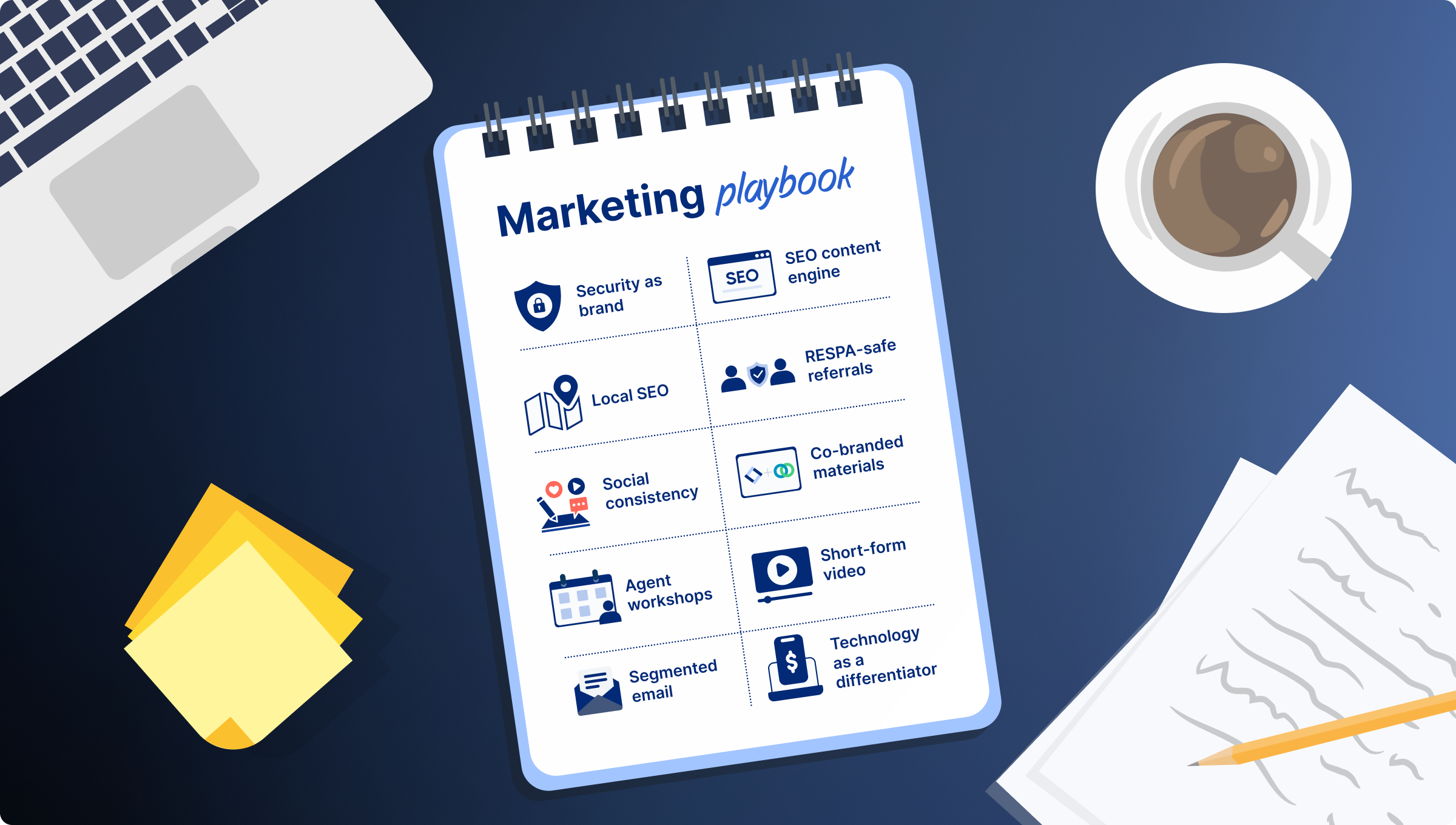
10 practical marketing ideas for title companies

Each idea below stands alone, but the strongest results come from stacking three or four into a 90-day sprint and measuring brand sentiment and order volume. Think execution, positive brand signals and ROI.
1. Turn your security posture into a brand story
According to the 2026 State of Wire Fraud Report, 85% of consumers are willing to pay extra for identity verification and wire fraud protection. That number belongs in your headline, not buried in an industry white paper.
Operationalize this into "close with confidence" messaging across your website, email signatures, and agent-facing collateral. Create a one-pager that translates your back-office security protocols (identity verification, bank account validation, insured wire transfers) into a story agents can carry into listing appointments.
CertifID's co-branded partner materials show what this looks like in practice: ready-made collateral that lets agents present security as a shared value rather than a title-company-only concern.
The key is specificity. Saying "We take security seriously" is vague, while stating. "Every wire is verified and insured up to $5M" provides clarity.
2. Build an SEO content engine around closing education
Two to four blog posts per month, anchored to questions agents and buyers actually search: "What does a title search reveal?" "How to avoid closing delays." "What happens if there's a lien on my house?"
The goal is owning the informational queries that precede a provider decision. A buyer Googling "what does title insurance cover" is six to eight weeks from closing, and their agent is choosing a title company right now. When your blog shows up, you're the firm that seems most knowledgeable.
Track it on a simple content calendar. Publish consistently good educational content, and your title company will become an expert in the field.
3. Dominate local SEO before your competitors notice
Three moves, in order:
- Claim and fully set up your Google Business Profile with photos, business hours, service descriptions, and a detailed "about" section
- Build dedicated landing pages targeting "title company in [city]" for every market you serve. Make sure that these pages provide quality content, describe how you serve customers in each location
- Collect a Google review after every closing, ideally from the agent and the buyer. Build your online reputation, step-by-step. Both your partners and your customers check what online reviews say about your title business.
Local SEO captures high-intent searches at near-zero ongoing cost. Someone searching "title company in Scottsdale" has already decided they need you. They're choosing between you and whoever else shows up.
This is one of the highest-ROI channels available to any title firm, and most of your competitors haven't touched it beyond claiming a basic listing.
4. Launch a RESPA-compliant realtor referral program
Under RESPA Section 8, paying a real estate agent anything of value in exchange for a referral is illegal. Penalties reach $10,000 and up to one year of imprisonment per violation, plus civil penalties up to three times the improper payment.
"Thing of value" is defined broadly. It covers cash, gifts, discounts, free services, paid lunches, and defrayed expenses. So the challenge is about building a referral program that still generates business without crossing into prohibited territory.
The CFPB's two-prong test: a promotional or educational activity is allowed only if (1) it's not conditioned on referrals, and (2) it doesn't defray expenses the agent would otherwise pay themselves.
What that looks like in practice:
- Co-branded materials: Permissible when offered to all agents in your market, not just those who send you files. The moment access is limited to referral sources, it becomes a "thing of value" tied to business
- Joint advertising: Allowed when each party pays a pro-rata share of the cost based on their share of the ad (size, placement, airtime). If the title company picks up more than its share, the difference is a kickback
- Educational events: Allowed if attendance is open and not conditioned on referrals, and the event isn't replacing CE an agent would otherwise pay for
- Closing gifts and lunches: High-risk. A title company paying for lunch at an agent's open house has been cited as a textbook RESPA violation
- MLS dues, marketing costs, admin support tied to referral volume: Clearly prohibited
Run every initiative past compliance counsel before launch. Even the highest-ROI campaign backfires if it crosses a regulatory line.
5. Use social media to stay visible to your closest agents
Three to five posts per week on LinkedIn and Facebook covering closing tips, local market data, team highlights, and quick fraud-prevention reminders. Commit to 12 months before you judge results.
The goal is to stay top-of-mind with the 50 to 200 agents and loan officers in your referral network. Social media for title companies is a consistent play. The agent who sees your name three times a week is more likely to recommend you than one who saw your ad once six months ago.
6. Create co-branded materials that agents actually want
The most reliable referral driver is making your agents look good in front of their clients. Co-branded materials do that work for them.
The formats that get used consistently are co-branded flyers for listing presentations, social media graphics that agents can repost, and homebuyer checklists that walk clients through what to expect at closing.
The value to the agent is having ready-made content that makes them look prepared and professional without creating anything from scratch. The value to you is your logo sitting next to theirs in front of every prospect they pitch.
Four principles for materials that actually get used:
- Make them editable: Agents should be able to swap in their own headshot and contact info without going back to you for a new file
- Solve a specific moment: A flyer for the listing presentation or a checklist for the closing handoff outperforms a vague “general info” piece every time
- Reinforce why they recommend you: Build in a security or fraud-prevention angle when relevant, so the materials work double duty as a trust signal.
- Offer them to every agent in your market. Limiting access to referral sources turns the materials into a “thing of value” under RESPA Section 8. Open distribution keeps you compliant and widens the funnel.
7. Host quarterly workshops or webinars for agents
Organize events on topics agents genuinely care about: contract-to-close timelines, title insurance basics for new agents, wire fraud red flags, or market-specific regulatory updates. Record every session for on-demand replay to extend shelf life.
This is a trust-building tactic that also creates reusable content. One 45-minute webinar yields clips for social media, an email recap, a blog post summary, and a replay you can gate behind an email capture form.
8. Invest in short-form video (60–90 seconds)
Three starter video types that require zero production budget:
- Staff introductions so agents see who they'll be working with
- Title-concept explainers, like “What is a title commitment?" in 60 seconds
- Office-technology walk-throughs that show how a digital closing actually works at your firm
Video outperforms static posts on every social platform. Production quality matters less than consistency and authenticity.
A phone camera with good lighting is enough to humanize your brand to referral partners who've never visited your office. Post weekly, plan ahead, and don’t let your channel go silent.
9. Build an email nurture sequence segmented by role
Segment your list into three tracks: a realtor-focused sequence with monthly market data, closing tips, and event invitations; a lender track emphasizing turnaround times and technology; and a direct consumer track with closing education and fraud-prevention guidance.
Email marketing returns an average of $36 for every $1 spent, according to Litmus. That ROI case is concrete, but only if you segment. Agents don't want the same content as first-time homebuyers. Relevance drives opens, and opens drive referrals.
10. Market your technology as a differentiator
If you offer digital payments, eClosing, or automated payoff ordering, those capabilities deserve dedicated landing pages and agent-facing one-pagers that translate technology into buyer-convenience stories.
According to CertifID data, over half of buyers choose the digital payment option when offered. Platforms like CertifID, which combine verification, payments, and eSigning in one platform, show what technology as a differentiator looks like in practice.
The pitch to agents: "Your buyers can pay their earnest money deposit from their phone at 10 PM on a Sunday, and you'll both get a confirmation within minutes."
Marketing tactic comparison
Launching tactics is the starting line. Knowing which ones drive orders separates a marketing plan from a wish list.
How to measure marketing ROI in your business
Ground your measurement in three numbers: new orders attributed to each channel, cost per acquired order, and referral-partner retention rate over 12 months.
The practical toolkit doesn't require expensive software. Add UTM parameters to every digital campaign link.
Include "how did you hear about us?" on every intake form.
Maintain a basic dashboard combining your CRM data, Google Analytics, and a weekly spreadsheet of order sources.
A basic system someone actually updates beats expensive software nobody touches.
The metrics that matter for title companies
Categorize every new order by channel (referral, organic search, social, email, paid) and review monthly trends.
Firms that track channel-level ROI consistently reallocate budget toward their highest-performing tactics and grow faster than those spending blindly.
The discipline is straightforward. Spend 15 minutes each week logging the source of each new order. Over 90 days, you'll see patterns that make your next marketing dollar dramatically more effective.
Where title company marketing is heading in 2026 and beyond
Two data points frame what's coming. First, 82% of consumers are aware that AI can be used to impersonate trusted parties during real estate transactions (Source: 2026 State of Wire Fraud Report).
Second, BEC attacks have surged 1,760% year-over-year since generative AI tools became widely available (Source: 2026 State of Wire Fraud Report). Fraud awareness has moved from a niche concern to a mainstream expectation for buyers.
Title companies positioning security as a brand pillar, rather than a back-office checkbox, will attract the most forward-thinking agents and build referral relationships that compound year over year.
Sign up for CertifID newsletter to get more useful tips and learn more about fraud prevention in real estate.

FAQ
What is the most cost-effective marketing strategy for a title company?

Local SEO and Google Business Profile setup consistently deliver the highest ROI for title firms. Pair them with a systematic review-collection process after every closing, and you create a self-reinforcing visibility loop that generates inbound inquiries without paid advertising. The upfront investment is time, which makes this accessible to firms of any size.
How often should a title company post on social media?
Three to five posts per week on LinkedIn and Facebook, aimed at the 50 to 200 agents and loan officers in your referral network. Twelve-month consistency outperforms a two-month burst followed by silence. You're building familiarity, and that is what agents rely on when choosing a title partner.
Can fraud prevention and security actually generate new business?
Yes, and the data is increasingly hard to ignore. 79% of consumers would pay more for a security-first business, and 85% are willing to pay extra for identity verification and wire fraud protection (Source: 2026 State of Wire Fraud Report).
Marketing those capabilities directly to agents turns a cost center into a referral driver, especially when you give agents co-branded collateral that makes the security story easy to tell.
How long does it take for title company marketing to show results?
It depends on the channel. Digital tactics like SEO and content marketing typically take up to six months to show measurable impact. Relationship-based tactics, including co-branded materials, referral programs, and agent workshops, can generate orders within weeks. The most important commitment is a 12-month timeline rather than expecting immediate returns from any single channel. Results come faster than most firms expect once multiple tactics compound together.

Content Marketer

Michelle has spent her career in B2B SaaS startups leading content marketing, strategy, and social media efforts that help teams grow and audiences stay informed. At CertifID, she applies that expertise to help title and real estate professionals understand fraud risks and stay ahead of emerging threats.
Most title companies are good at the work and bad at talking about it. The deal closes, the wire lands, the file gets archived, and the agent who referred it forgets who you are by the next listing.
That's the marketing problem in one sentence. Title work is invisible by design, which means your referral partners don't feel the value unless you put it in front of them. This article covers 10 practical ways to do that, from local SEO to co-branded materials agents actually want to use.
What is title company marketing?
Title company marketing is the set of activities a title firm uses to stay top-of-mind with the people who decide which title company handles a transaction: primarily real estate agents and loan officers, and secondarily homebuyers and sellers.
Because the audience is professional and local, the channels are too. LinkedIn and Facebook are where agents network and post listings. Google Search is where buyers and agents look up providers and definitions. Industry events and brokerage offices are where relationships get built face-to-face. Email is where agents actually read updates between closings.
Effective title marketing shows up where people already spend their day, not on billboards.
Why marketing for title companies is different from other industries
Realtors and loan officers drive the vast majority of title company selection in residential transactions. That single fact reshapes everything.
Unlike a consumer brand selling directly to end users, your true audience is the agent deciding which title company to recommend before the buyer even knows they need one. The buyer rarely shops around. They go with who their agent suggests.
Every marketing dollar needs to build professional trust signals agents can point to: closing speed, error rates, fraud prevention, and technology. If a tactic doesn't strengthen an agent's confidence in recommending you, rethink it.
Why many title companies get it wrong
Many title firms fall into one of two traps. They either market like a consumer brand, running generic Facebook ads to homebuyers who have no say in the matter, or they rely entirely on relationship-based lunches that can't scale past one rep's contact list. Both approaches leave a gap between the value you deliver and the value your referral partners can actually feel.
There's also a quieter mistake: staying silent about what makes you different. According to the 2026 State of Wire Fraud Report, 56% of consumers would switch providers after a single fraud incident, even if funds were recovered.
Yet most title companies never communicate their security posture to the agents recommending them.
They sit in the transaction as a silent partner, deferring the optics to the real estate agent, the lender, or the builder. When agents don't know you're the safer option, they have no reason to defend your name when a competitor buys them lunch.
10 practical marketing ideas for title companies
Each idea below stands alone, but the strongest results come from stacking three or four into a 90-day sprint and measuring brand sentiment and order volume. Think execution, positive brand signals and ROI.
1. Turn your security posture into a brand story
According to the 2026 State of Wire Fraud Report, 85% of consumers are willing to pay extra for identity verification and wire fraud protection. That number belongs in your headline, not buried in an industry white paper.
Operationalize this into "close with confidence" messaging across your website, email signatures, and agent-facing collateral. Create a one-pager that translates your back-office security protocols (identity verification, bank account validation, insured wire transfers) into a story agents can carry into listing appointments.
CertifID's co-branded partner materials show what this looks like in practice: ready-made collateral that lets agents present security as a shared value rather than a title-company-only concern.
The key is specificity. Saying "We take security seriously" is vague, while stating. "Every wire is verified and insured up to $5M" provides clarity.
2. Build an SEO content engine around closing education
Two to four blog posts per month, anchored to questions agents and buyers actually search: "What does a title search reveal?" "How to avoid closing delays." "What happens if there's a lien on my house?"
The goal is owning the informational queries that precede a provider decision. A buyer Googling "what does title insurance cover" is six to eight weeks from closing, and their agent is choosing a title company right now. When your blog shows up, you're the firm that seems most knowledgeable.
Track it on a simple content calendar. Publish consistently good educational content, and your title company will become an expert in the field.
3. Dominate local SEO before your competitors notice
Three moves, in order:
- Claim and fully set up your Google Business Profile with photos, business hours, service descriptions, and a detailed "about" section
- Build dedicated landing pages targeting "title company in [city]" for every market you serve. Make sure that these pages provide quality content, describe how you serve customers in each location
- Collect a Google review after every closing, ideally from the agent and the buyer. Build your online reputation, step-by-step. Both your partners and your customers check what online reviews say about your title business.
Local SEO captures high-intent searches at near-zero ongoing cost. Someone searching "title company in Scottsdale" has already decided they need you. They're choosing between you and whoever else shows up.
This is one of the highest-ROI channels available to any title firm, and most of your competitors haven't touched it beyond claiming a basic listing.
4. Launch a RESPA-compliant realtor referral program
Under RESPA Section 8, paying a real estate agent anything of value in exchange for a referral is illegal. Penalties reach $10,000 and up to one year of imprisonment per violation, plus civil penalties up to three times the improper payment.
"Thing of value" is defined broadly. It covers cash, gifts, discounts, free services, paid lunches, and defrayed expenses. So the challenge is about building a referral program that still generates business without crossing into prohibited territory.
The CFPB's two-prong test: a promotional or educational activity is allowed only if (1) it's not conditioned on referrals, and (2) it doesn't defray expenses the agent would otherwise pay themselves.
What that looks like in practice:
- Co-branded materials: Permissible when offered to all agents in your market, not just those who send you files. The moment access is limited to referral sources, it becomes a "thing of value" tied to business
- Joint advertising: Allowed when each party pays a pro-rata share of the cost based on their share of the ad (size, placement, airtime). If the title company picks up more than its share, the difference is a kickback
- Educational events: Allowed if attendance is open and not conditioned on referrals, and the event isn't replacing CE an agent would otherwise pay for
- Closing gifts and lunches: High-risk. A title company paying for lunch at an agent's open house has been cited as a textbook RESPA violation
- MLS dues, marketing costs, admin support tied to referral volume: Clearly prohibited
Run every initiative past compliance counsel before launch. Even the highest-ROI campaign backfires if it crosses a regulatory line.
5. Use social media to stay visible to your closest agents
Three to five posts per week on LinkedIn and Facebook covering closing tips, local market data, team highlights, and quick fraud-prevention reminders. Commit to 12 months before you judge results.
The goal is to stay top-of-mind with the 50 to 200 agents and loan officers in your referral network. Social media for title companies is a consistent play. The agent who sees your name three times a week is more likely to recommend you than one who saw your ad once six months ago.
6. Create co-branded materials that agents actually want
The most reliable referral driver is making your agents look good in front of their clients. Co-branded materials do that work for them.
The formats that get used consistently are co-branded flyers for listing presentations, social media graphics that agents can repost, and homebuyer checklists that walk clients through what to expect at closing.
The value to the agent is having ready-made content that makes them look prepared and professional without creating anything from scratch. The value to you is your logo sitting next to theirs in front of every prospect they pitch.
Four principles for materials that actually get used:
- Make them editable: Agents should be able to swap in their own headshot and contact info without going back to you for a new file
- Solve a specific moment: A flyer for the listing presentation or a checklist for the closing handoff outperforms a vague “general info” piece every time
- Reinforce why they recommend you: Build in a security or fraud-prevention angle when relevant, so the materials work double duty as a trust signal.
- Offer them to every agent in your market. Limiting access to referral sources turns the materials into a “thing of value” under RESPA Section 8. Open distribution keeps you compliant and widens the funnel.
7. Host quarterly workshops or webinars for agents
Organize events on topics agents genuinely care about: contract-to-close timelines, title insurance basics for new agents, wire fraud red flags, or market-specific regulatory updates. Record every session for on-demand replay to extend shelf life.
This is a trust-building tactic that also creates reusable content. One 45-minute webinar yields clips for social media, an email recap, a blog post summary, and a replay you can gate behind an email capture form.
8. Invest in short-form video (60–90 seconds)
Three starter video types that require zero production budget:
- Staff introductions so agents see who they'll be working with
- Title-concept explainers, like “What is a title commitment?" in 60 seconds
- Office-technology walk-throughs that show how a digital closing actually works at your firm
Video outperforms static posts on every social platform. Production quality matters less than consistency and authenticity.
A phone camera with good lighting is enough to humanize your brand to referral partners who've never visited your office. Post weekly, plan ahead, and don’t let your channel go silent.
9. Build an email nurture sequence segmented by role
Segment your list into three tracks: a realtor-focused sequence with monthly market data, closing tips, and event invitations; a lender track emphasizing turnaround times and technology; and a direct consumer track with closing education and fraud-prevention guidance.
Email marketing returns an average of $36 for every $1 spent, according to Litmus. That ROI case is concrete, but only if you segment. Agents don't want the same content as first-time homebuyers. Relevance drives opens, and opens drive referrals.
10. Market your technology as a differentiator
If you offer digital payments, eClosing, or automated payoff ordering, those capabilities deserve dedicated landing pages and agent-facing one-pagers that translate technology into buyer-convenience stories.
According to CertifID data, over half of buyers choose the digital payment option when offered. Platforms like CertifID, which combine verification, payments, and eSigning in one platform, show what technology as a differentiator looks like in practice.
The pitch to agents: "Your buyers can pay their earnest money deposit from their phone at 10 PM on a Sunday, and you'll both get a confirmation within minutes."
Marketing tactic comparison
Launching tactics is the starting line. Knowing which ones drive orders separates a marketing plan from a wish list.
How to measure marketing ROI in your business
Ground your measurement in three numbers: new orders attributed to each channel, cost per acquired order, and referral-partner retention rate over 12 months.
The practical toolkit doesn't require expensive software. Add UTM parameters to every digital campaign link.
Include "how did you hear about us?" on every intake form.
Maintain a basic dashboard combining your CRM data, Google Analytics, and a weekly spreadsheet of order sources.
A basic system someone actually updates beats expensive software nobody touches.
The metrics that matter for title companies
Categorize every new order by channel (referral, organic search, social, email, paid) and review monthly trends.
Firms that track channel-level ROI consistently reallocate budget toward their highest-performing tactics and grow faster than those spending blindly.
The discipline is straightforward. Spend 15 minutes each week logging the source of each new order. Over 90 days, you'll see patterns that make your next marketing dollar dramatically more effective.
Where title company marketing is heading in 2026 and beyond
Two data points frame what's coming. First, 82% of consumers are aware that AI can be used to impersonate trusted parties during real estate transactions (Source: 2026 State of Wire Fraud Report).
Second, BEC attacks have surged 1,760% year-over-year since generative AI tools became widely available (Source: 2026 State of Wire Fraud Report). Fraud awareness has moved from a niche concern to a mainstream expectation for buyers.
Title companies positioning security as a brand pillar, rather than a back-office checkbox, will attract the most forward-thinking agents and build referral relationships that compound year over year.
Sign up for CertifID newsletter to get more useful tips and learn more about fraud prevention in real estate.
Content Marketer
Michelle has spent her career in B2B SaaS startups leading content marketing, strategy, and social media efforts that help teams grow and audiences stay informed. At CertifID, she applies that expertise to help title and real estate professionals understand fraud risks and stay ahead of emerging threats.
Sign up for The Wire to join the conversation.







Austin
3601 South Congress Ave.
Ste D200, Austin, Texas 78704

Grand Rapids
124 Fulton Street E
Grand Rapids, MI 49503

