


Victim of wire fraud? Here’s what to do next
If funds from your closing just went to the wrong account, start here. Six steps in order of urgency, beginning with the two that can't wait until tomorrow.
Share article:


Katie Stewart
4 minutes
Wire Fraud
Sep 2, 2026
Sep 2, 2026
Quick Summary
Your first call should be to the financial institution that sent the funds. Report the transfer as fraudulent and request an immediate wire recall. Then file a detailed complaint at ic3.gov. When a transaction qualifies, the FBI's Recovery Asset Team may use its Financial Fraud Kill Chain process to help financial institutions and law enforcement freeze the funds. Speed matters, so start these steps as soon as the fraud is discovered.
When fraud hits a closing, everything feels urgent because it is
If a party in your closing just wired funds to a fraudulent account, you already know something is very wrong. Maybe it's a buyer's cash to close that went to the wrong place. Maybe a payoff was diverted. Either way, you're probably sitting with that mix of urgency and disbelief that every closing agent and attorney in this situation describes.
That reaction is normal, and it's one we see constantly. Closing agents who've been through this describe the same mix of emotions. They feel the weight of it, worry they should have caught it, and dread telling the client. If you're feeling all of that right now, you're not alone in it.
But what matters most right now is that you can still act. Speed is the single biggest factor in whether your client's funds come back.
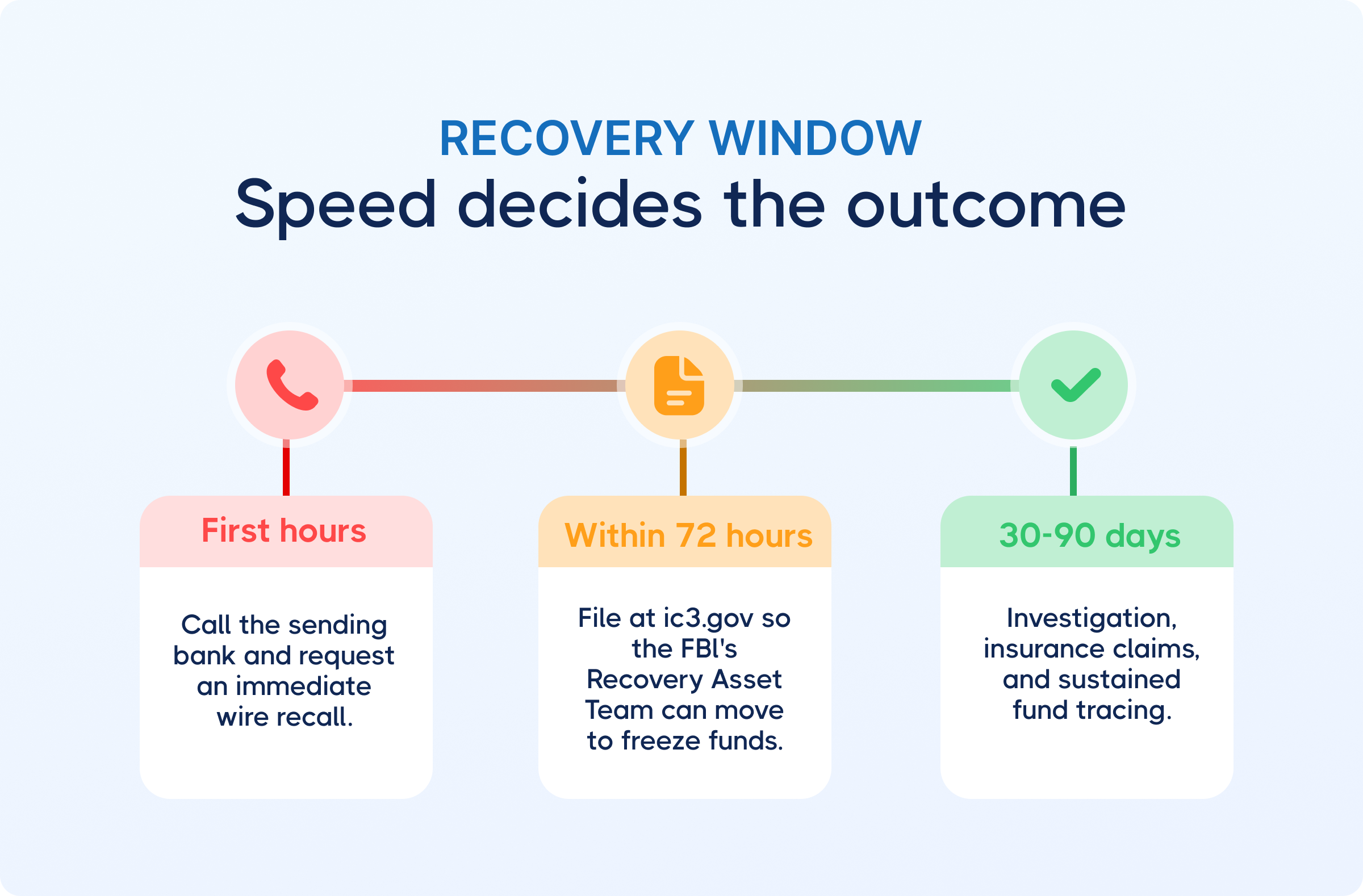
The six steps below are ordered by urgency. The first two should happen within hours, ideally before the end of business today.
How to respond when wire fraud hits your closing
1. Take a breath and know you're not alone
If you just discovered that funds from a closing went to the wrong account, you're probably in shock. That's a completely normal reaction to an abnormal situation.
Payment fraud is one of the most disorienting things that can happen during a closing. You did everything you were supposed to do, and someone exploited the process anyway.
You might be a closing agent who followed wiring instructions that looked completely legitimate. You might be a buyer who sent your entire down payment to the wrong account. Or you might be the attorney who just got a panicked call from a client. Whatever your role, fear and guilt hit at the same time, along with an urgency that makes it hard to think clearly.
None of this is your fault. Fraudsters spend weeks inside email threads, learning names, studying timelines, and crafting instructions that are nearly impossible to tell apart from the real ones.
The FBI investigates thousands of these cases every year. In 2025, the IC3 received over 12,000 real estate fraud complaints tied to $275 million in losses.
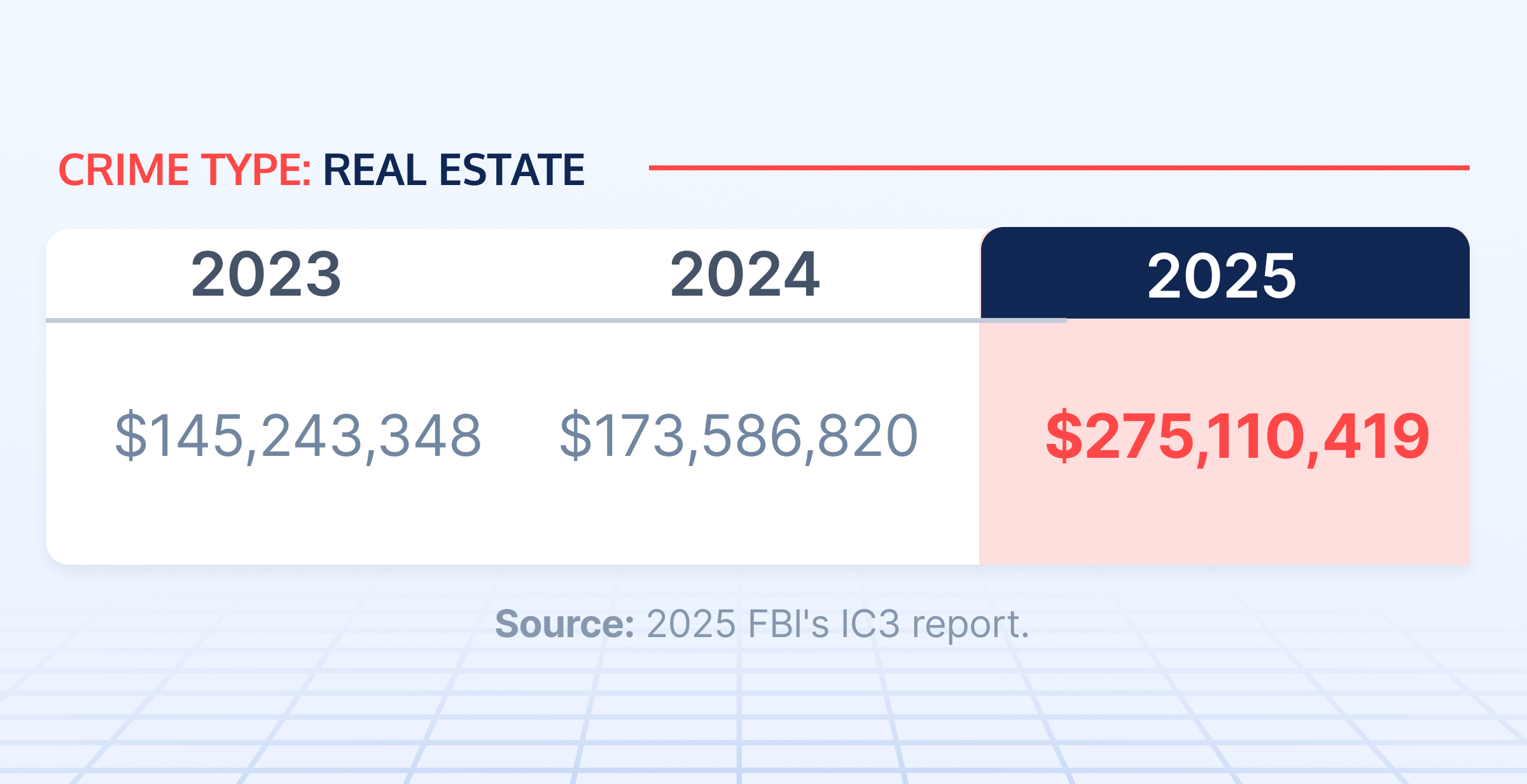
You're dealing with organized, well-funded criminals, and payment fraud prevention exists because this problem is that widespread.
But you do need to act fast. Before you do anything else, write down everything you can remember while it's fresh. Note when you received the fraudulent instructions, who they appeared to come from, and when the wire was sent. Every detail matters later, and you won't remember it as clearly once the adrenaline fades.
Then move to Step 2. The window for recovering your funds is narrow, and every hour counts.
2. Call your bank and request a recall
This is the most time-sensitive step. The moment you realize the wire went to the wrong account, call the bank that sent the funds. Don't email. Don't use the secure portal. Pick up the phone and call the fraud department or wire transfer desk directly.
Ask the bank to initiate an immediate recall of the fraudulent wire and contact the receiving bank. Depending on the payment network and the banks involved, the bank may use Fedwire, SWIFT, or another interbank process to send the recall request. It doesn't guarantee the money comes back, but it's the fastest way to recover a misdirected wire. When the recall goes out within the first few hours, there's a strong chance the funds haven't been moved yet.
Before you call, pull together the wire date and time, the amount, and any confirmation numbers. You'll also need the receiving account details and copies of the emails with the fraudulent instructions.
If you still have the legitimate wiring instructions, keep them side by side so you can point out the differences. Knowing how to validate wire instructions can help you spot those discrepancies. Having all of this ready means the fraud team can act faster instead of calling you back.
Don't assume you have until the next business day. Many U.S. domestic wires move through systems such as Fedwire, where settlement between financial institutions can happen in real time. Even after a wire has settled, the receiving bank may still be able to restrict the beneficiary account or return available funds, but the opportunity generally gets smaller as the fraudster moves the money elsewhere.
Also contact the receiving bank's fraud department, tell them a fraudulent wire recall has been initiated, and ask whether they can restrict the receiving account. What the bank can do will depend on the status of the funds, applicable law, and its internal procedures.
If you're a title company or law firm handling the closing, your sending bank is typically the one holding your escrow or IOLTA account. Make sure you're speaking with someone who has the authority to initiate a recall. Ask for the fraud department directly.
3. Report to the FBI's Internet Crime Complaint Center
File a complaint at ic3.gov as soon as you've contacted your bank. The IC3 is where the FBI collects internet crime reports, and filing here does more than create a paper trail.
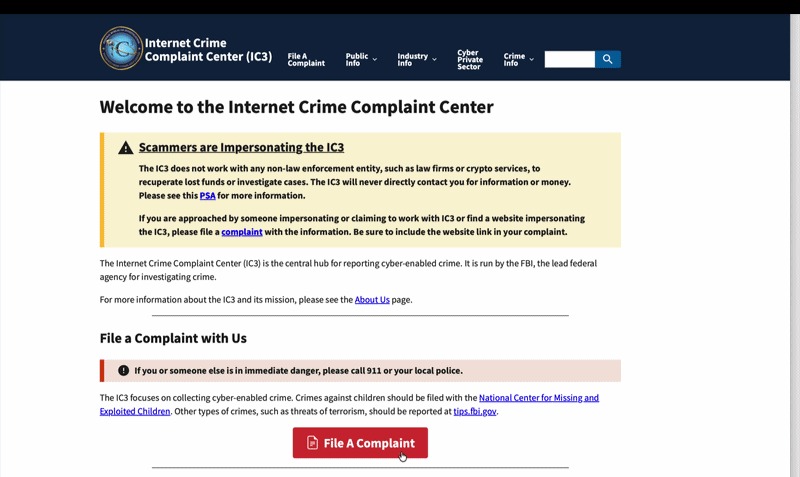
IC3 reviews complaints and, where a fraudulent transfer qualifies for intervention, its Recovery Asset Team (RAT) can use the Financial Fraud Kill Chain to coordinate with financial institutions, FBI field offices, and other law-enforcement partners to try to freeze the funds.
Historically, the FBI has emphasized reporting fraudulent transfers within 72 hours, and every delay gives criminals more time to move the funds through additional accounts. Recovery can still happen later, but it generally becomes more difficult as the money moves.
When you file, include every piece of documentation you have. That means the fraudulent emails, the legitimate instructions for comparison, the wire confirmation, and a timeline of how you discovered the fraud. The more detail IC3 has, the faster RAT can act.
Don't assume this only matters for large losses. The FBI's IC3 processes complaints of all sizes, and even smaller cases contribute to pattern identification that helps law enforcement track organized fraud rings.
4. Notify your title company and every party to the closing
If you're a buyer or seller, call your closing agent immediately. Your title company or attorney needs to know what happened so they can start their own recovery steps and notify the other parties.
If you're the title company or the attorney, this step is about making sure the compromised instructions don't travel any further. You need to alert every party to the closing before anyone else acts on it.
Start with your underwriter. Companies like Old Republic, Fidelity National Financial, and Stewart have fraud response teams and may have resources to help with recovery or insurance claims. They also need to know for their own risk tracking.
Then notify the real estate agents, the lender, and anyone else who had access to the wire instructions or the email thread. Any of them could still have the fraudulent instructions in their inbox and might unknowingly forward them. The faster each person learns the email chain was compromised, the lower the chance of a second fraud attempt on the same closing.
Determine whether any email account involved in the transaction was compromised. If your firm's account may have been accessed, involve IT immediately, reset affected credentials, review active sessions and forwarding rules, and enable or re-establish MFA. Ask the other parties to review their own accounts as well.
Last but not least here, keep a detailed incident log for your insurer, counsel, underwriter, law enforcement, and internal compliance records.
5. File a police report and check your insurance coverage
File a police report with your local law enforcement. Wire fraud is a federal crime and the FBI handles most investigations. But a local police report creates a separate official record you'll need for insurance claims and civil action.
Then review your firm's insurance coverage. This is often the second gut punch: most E&O policies exclude wire fraud losses. Cyber riders often have per-incident caps that are far lower than the amounts at stake in a real estate closing.
If you do have cyber or crime coverage that applies, file the claim immediately. Include the police report, your IC3 filing confirmation, and all documentation of the fraudulent wire and your recovery efforts. Insurance investigations can take 30 to 90 days, so the sooner you file, the sooner the process begins.
If you're a consumer who lost personal funds, check whether your homeowner's insurance or personal umbrella policy covers theft by wire fraud. Most don't, but it's worth confirming. Also ask your bank about their own fraud protection programs, because some do have support for victims of BEC. You can learn more about how wire fraud protection works and what to look for in a policy.
Even if your current coverage doesn't apply, file anyway. The police report and insurance filing create a legal record that protects you if recovery efforts succeed later or liability questions come up.
6. Bring in a professional recovery team
If you've followed Steps 1 through 5, you've done the most critical time-sensitive work. But wire fraud recovery doesn't end with a SWIFT recall and an IC3 complaint. In many cases, it's just beginning.
A dedicated fraud recovery team does what most individuals and firms can't do on their own. They coordinate across multiple banks and work directly with federal law enforcement. They also know how to trace funds that have already moved through several accounts or gone overseas. That's what separates one phone call to your bank from a real, sustained recovery effort.
CertifID is a closing platform built to prevent payment fraud and to recover funds when it happens. Our Fraud Recovery Services team has worked with more than 870 victims and recovered over $140 million in stolen funds. When a case comes in, we assign you a dedicated specialist who stays with you from the first call through resolution.
We coordinate directly with the sending and receiving banks, work with federal law enforcement, including the U.S. Secret Service, and trace funds across accounts to find where the money went. Many victims see significant funds returned within the first weeks.
If you or your firm is dealing with a payment fraud loss, you can reach our recovery team through our fraud recovery page.

FAQ
Can you get your money back after payment fraud?

Often, yes, and speed matters more than anything else here. The FBI's Recovery Asset Team freezes stolen funds in about two-thirds of cases reported within 72 hours. Past that window, recovery becomes harder because funds are often moved to secondary accounts or converted to cryptocurrency. If you're still inside the first 24 hours, that's the highest-leverage time you have. Use it.
How long does payment fraud recovery take?
It varies, and not knowing in the meantime is one of the hardest parts. An initial freeze can happen within days if you report quickly. But the full investigation and fund recovery can take 30 to 90 days or longer, depending on how many banks are involved and whether funds crossed borders. A dedicated recovery team can speed this up and can at least give you a real timeline instead of a guess.
Who is liable when payment fraud happens during a closing?
Right now, liability probably isn't the most urgent question; recovery is. But it's fair to want to know where you stand: it depends on the facts of the case and state law. Courts have found title companies, law firms, and real estate brokerages liable in some cases, especially when email security practices fell short. Talk to an attorney who handles payment fraud cases to understand your exposure. In the meantime, taking every recovery step available protects the people counting on you, your client first, and your firm, too.
Should I tell my client what happened?
Yes, and as soon as you can. Your client is a victim here, too, and they deserve to hear it from you directly, before they find out any other way. Encourage them to file their own IC3 complaint and watch their accounts for further activity. This conversation is hard, but handling it honestly is what actually protects the relationship more than anything you could do after the fact.

VP of Customer Success

Katie's background combines both IT and education. Her degree is in Management Information Systems, and she spent her first four years in the workforce as an IT business analyst. Katie took a career turn and joined Teach for America and worked in inner-city schools in Indianapolis as a math teacher and eventually an assistant principal. Today she combines her IT nerdiness and love of teaching, helping customers find success every day.
Quick Summary
Your first call should be to the financial institution that sent the funds. Report the transfer as fraudulent and request an immediate wire recall. Then file a detailed complaint at ic3.gov. When a transaction qualifies, the FBI's Recovery Asset Team may use its Financial Fraud Kill Chain process to help financial institutions and law enforcement freeze the funds. Speed matters, so start these steps as soon as the fraud is discovered.
When fraud hits a closing, everything feels urgent because it is
If a party in your closing just wired funds to a fraudulent account, you already know something is very wrong. Maybe it's a buyer's cash to close that went to the wrong place. Maybe a payoff was diverted. Either way, you're probably sitting with that mix of urgency and disbelief that every closing agent and attorney in this situation describes.
That reaction is normal, and it's one we see constantly. Closing agents who've been through this describe the same mix of emotions. They feel the weight of it, worry they should have caught it, and dread telling the client. If you're feeling all of that right now, you're not alone in it.
But what matters most right now is that you can still act. Speed is the single biggest factor in whether your client's funds come back.
The six steps below are ordered by urgency. The first two should happen within hours, ideally before the end of business today.
How to respond when wire fraud hits your closing
1. Take a breath and know you're not alone
If you just discovered that funds from a closing went to the wrong account, you're probably in shock. That's a completely normal reaction to an abnormal situation.
Payment fraud is one of the most disorienting things that can happen during a closing. You did everything you were supposed to do, and someone exploited the process anyway.
You might be a closing agent who followed wiring instructions that looked completely legitimate. You might be a buyer who sent your entire down payment to the wrong account. Or you might be the attorney who just got a panicked call from a client. Whatever your role, fear and guilt hit at the same time, along with an urgency that makes it hard to think clearly.
None of this is your fault. Fraudsters spend weeks inside email threads, learning names, studying timelines, and crafting instructions that are nearly impossible to tell apart from the real ones.
The FBI investigates thousands of these cases every year. In 2025, the IC3 received over 12,000 real estate fraud complaints tied to $275 million in losses.
You're dealing with organized, well-funded criminals, and payment fraud prevention exists because this problem is that widespread.
But you do need to act fast. Before you do anything else, write down everything you can remember while it's fresh. Note when you received the fraudulent instructions, who they appeared to come from, and when the wire was sent. Every detail matters later, and you won't remember it as clearly once the adrenaline fades.
Then move to Step 2. The window for recovering your funds is narrow, and every hour counts.
2. Call your bank and request a recall
This is the most time-sensitive step. The moment you realize the wire went to the wrong account, call the bank that sent the funds. Don't email. Don't use the secure portal. Pick up the phone and call the fraud department or wire transfer desk directly.
Ask the bank to initiate an immediate recall of the fraudulent wire and contact the receiving bank. Depending on the payment network and the banks involved, the bank may use Fedwire, SWIFT, or another interbank process to send the recall request. It doesn't guarantee the money comes back, but it's the fastest way to recover a misdirected wire. When the recall goes out within the first few hours, there's a strong chance the funds haven't been moved yet.
Before you call, pull together the wire date and time, the amount, and any confirmation numbers. You'll also need the receiving account details and copies of the emails with the fraudulent instructions.
If you still have the legitimate wiring instructions, keep them side by side so you can point out the differences. Knowing how to validate wire instructions can help you spot those discrepancies. Having all of this ready means the fraud team can act faster instead of calling you back.
Don't assume you have until the next business day. Many U.S. domestic wires move through systems such as Fedwire, where settlement between financial institutions can happen in real time. Even after a wire has settled, the receiving bank may still be able to restrict the beneficiary account or return available funds, but the opportunity generally gets smaller as the fraudster moves the money elsewhere.
Also contact the receiving bank's fraud department, tell them a fraudulent wire recall has been initiated, and ask whether they can restrict the receiving account. What the bank can do will depend on the status of the funds, applicable law, and its internal procedures.
If you're a title company or law firm handling the closing, your sending bank is typically the one holding your escrow or IOLTA account. Make sure you're speaking with someone who has the authority to initiate a recall. Ask for the fraud department directly.
3. Report to the FBI's Internet Crime Complaint Center
File a complaint at ic3.gov as soon as you've contacted your bank. The IC3 is where the FBI collects internet crime reports, and filing here does more than create a paper trail.
IC3 reviews complaints and, where a fraudulent transfer qualifies for intervention, its Recovery Asset Team (RAT) can use the Financial Fraud Kill Chain to coordinate with financial institutions, FBI field offices, and other law-enforcement partners to try to freeze the funds.
Historically, the FBI has emphasized reporting fraudulent transfers within 72 hours, and every delay gives criminals more time to move the funds through additional accounts. Recovery can still happen later, but it generally becomes more difficult as the money moves.
When you file, include every piece of documentation you have. That means the fraudulent emails, the legitimate instructions for comparison, the wire confirmation, and a timeline of how you discovered the fraud. The more detail IC3 has, the faster RAT can act.
Don't assume this only matters for large losses. The FBI's IC3 processes complaints of all sizes, and even smaller cases contribute to pattern identification that helps law enforcement track organized fraud rings.
4. Notify your title company and every party to the closing
If you're a buyer or seller, call your closing agent immediately. Your title company or attorney needs to know what happened so they can start their own recovery steps and notify the other parties.
If you're the title company or the attorney, this step is about making sure the compromised instructions don't travel any further. You need to alert every party to the closing before anyone else acts on it.
Start with your underwriter. Companies like Old Republic, Fidelity National Financial, and Stewart have fraud response teams and may have resources to help with recovery or insurance claims. They also need to know for their own risk tracking.
Then notify the real estate agents, the lender, and anyone else who had access to the wire instructions or the email thread. Any of them could still have the fraudulent instructions in their inbox and might unknowingly forward them. The faster each person learns the email chain was compromised, the lower the chance of a second fraud attempt on the same closing.
Determine whether any email account involved in the transaction was compromised. If your firm's account may have been accessed, involve IT immediately, reset affected credentials, review active sessions and forwarding rules, and enable or re-establish MFA. Ask the other parties to review their own accounts as well.
Last but not least here, keep a detailed incident log for your insurer, counsel, underwriter, law enforcement, and internal compliance records.
5. File a police report and check your insurance coverage
File a police report with your local law enforcement. Wire fraud is a federal crime and the FBI handles most investigations. But a local police report creates a separate official record you'll need for insurance claims and civil action.
Then review your firm's insurance coverage. This is often the second gut punch: most E&O policies exclude wire fraud losses. Cyber riders often have per-incident caps that are far lower than the amounts at stake in a real estate closing.
If you do have cyber or crime coverage that applies, file the claim immediately. Include the police report, your IC3 filing confirmation, and all documentation of the fraudulent wire and your recovery efforts. Insurance investigations can take 30 to 90 days, so the sooner you file, the sooner the process begins.
If you're a consumer who lost personal funds, check whether your homeowner's insurance or personal umbrella policy covers theft by wire fraud. Most don't, but it's worth confirming. Also ask your bank about their own fraud protection programs, because some do have support for victims of BEC. You can learn more about how wire fraud protection works and what to look for in a policy.
Even if your current coverage doesn't apply, file anyway. The police report and insurance filing create a legal record that protects you if recovery efforts succeed later or liability questions come up.
6. Bring in a professional recovery team
If you've followed Steps 1 through 5, you've done the most critical time-sensitive work. But wire fraud recovery doesn't end with a SWIFT recall and an IC3 complaint. In many cases, it's just beginning.
A dedicated fraud recovery team does what most individuals and firms can't do on their own. They coordinate across multiple banks and work directly with federal law enforcement. They also know how to trace funds that have already moved through several accounts or gone overseas. That's what separates one phone call to your bank from a real, sustained recovery effort.
CertifID is a closing platform built to prevent payment fraud and to recover funds when it happens. Our Fraud Recovery Services team has worked with more than 870 victims and recovered over $140 million in stolen funds. When a case comes in, we assign you a dedicated specialist who stays with you from the first call through resolution.
We coordinate directly with the sending and receiving banks, work with federal law enforcement, including the U.S. Secret Service, and trace funds across accounts to find where the money went. Many victims see significant funds returned within the first weeks.
If you or your firm is dealing with a payment fraud loss, you can reach our recovery team through our fraud recovery page.
VP of Customer Success
Katie's background combines both IT and education. Her degree is in Management Information Systems, and she spent her first four years in the workforce as an IT business analyst. Katie took a career turn and joined Teach for America and worked in inner-city schools in Indianapolis as a math teacher and eventually an assistant principal. Today she combines her IT nerdiness and love of teaching, helping customers find success every day.
Sign up for The Wire to join the conversation.






Austin
3601 South Congress Ave.
Ste D200, Austin, Texas 78704

Grand Rapids
124 Fulton Street E
Grand Rapids, MI 49503

