


Can a Wire Transfer Be Reversed?
Wire transfers are generally considered final and irrevocable once the receiving bank accepts the funds. In most cases, a fraudulent wire cannot be reversed — only recalled, and only within a narrow window of hours. Once funds are moved or withdrawn, recovery depends on law enforcement, not your bank.
Share article:


Tom Cronkright
5 minutes
Fraud Recovery
Oct 4, 2022
Apr 21, 2026
"I remember the exact moment I got the call from my office saying, 'We wired a payoff yesterday, and the lender just called us and said they didn't receive the wire.'"
For Sarah, a title agent with over 20 years of experience, this was the moment she learned a harsh truth: wire transfers are irreversible once completed.
It's a scenario that's becoming more common. According to CertifID's 2026 State of Wire Fraud Report, BEC attacks — the category that includes wire fraud targeting real estate closings — have surged 1,760% since generative AI tools became widely available. Fraudsters are faster, more convincing, and harder to detect than ever before.
Once a wire transfer is sent, reversing it is difficult and never guaranteed. Recovery is sometimes possible — CertifID's Fraud Recovery Services has helped return over $118.4 million in stolen funds with a 69% recovery rate — but speed is everything, and even successful recoveries come at high cost in time, stress, and uncertainty. Prevention is always a better outcome than recovery.
Read on to learn how wire transfers work, when reversal is possible, and how to protect your business before fraud has a chance to strike.
The truth about wire transfer reversals
Every case of wire transfer reversal is going to be different.
To better understand your options, look at what happens when you try to revoke a wire transfer.

Generally, the longer it has been since the official initiation of a wire transfer through the SWIFT network, the lower the chances of stopping your wire transfer.
If you discover your wire transfer may be fraudulent, check this short video for immediate action steps:
First, contact your bank, the FBI’s Internet Crime Complaint Center (IC3), and local law enforcement.
Banks and the SWIFT system perform anti-fraud checks, verify accounts, and may hold funds. This verification process typically takes 1-4 business days. It’s longer for international banks or when holidays are involved.
Your bank can use the SWIFT system’s Federal Reference Number to track the status of a transfer.
However, once a transfer is started and accepted by the receiving bank, it is nearly impossible to cancel the transfer or have all stolen money recovered.
At this point, you're no longer dealing with a wire reversal—you're dealing with wire fraud.
Why wire transfers are legally final
The legal basis for wire transfer finality is UCC Article 4A, adopted in all U.S. jurisdictions. Under UCC §§ 4A-209 and 4A-211, a wire transfer is accepted and final the moment funds are credited to the beneficiary's account. After that point, the transfer cannot be cancelled without the receiving bank's consent.
This statutory finality is why title companies bear direct liability when wires are misdirected. Unlike ACH transactions, which carry return rights for several business days, Fedwire transfers have no built-in reversal mechanism. The closing agent who sends a wire to a fraudulent account has, under the law, completed a final payment — regardless of the fraud that caused it.
This is precisely why prevention and verification before the wire is sent is the only legally reliable protection. Once the wire clears, your options narrow to recall requests and law enforcement — not rights.
Wire reversal vs. wire recall: what's the difference?
These two terms are often used interchangeably, but they describe different situations with different outcomes.
A wire reversal happens when a bank corrects an error it made — for example, if the bank sent the wrong amount, duplicated a transfer, or used the wrong account number.
In these cases, the bank is obligated to correct the mistake. Reversals are relatively straightforward when the error was the bank's.
A wire recall is a request made by the sending bank asking the receiving bank to voluntarily return funds. This is what happens when fraud is involved, or when the sender made a mistake.
The receiving bank has no legal obligation to comply. Under UCC Article 4A, once a wire is accepted — meaning it has been credited to the beneficiary's account — the payment is final. The receiving bank can only return funds voluntarily, and only if those funds haven't already been moved.
In real estate fraud cases, you are almost always dealing with a recall situation, not a reversal. That distinction matters because it determines your leverage and your timeline.
What to do if you sent a wire to a scammer
If you’re in real estate and suspect a wire transfer was fraudulent, every minute matters. Take these steps immediately:
First, contact your bank, the FBI’s Internet Crime Complaint Center (IC3), and local law enforcement.
Banks and the SWIFT system perform anti-fraud checks, verify accounts, and may hold funds. This verification process typically takes 1-4 business days. It’s longer for international banks or when holidays are involved.
Your bank can use the SWIFT system’s Federal Reference Number to track the status of a transfer.
However, once a transfer is started and accepted by the receiving bank, it is nearly impossible to cancel the transfer or have all stolen money recovered.
At this point, you're no longer dealing with a wire reversal—you're dealing with wire fraud.
When wire reversal fails: understanding the impact
And this is where the true nightmare may begin for your business.
Once the receiving bank accepts the transfer, the impact goes far beyond just lost customer funds.
Your business faces multiple risks:
- You may be personally liable for the lost funds
- Your professional license could be at risk
- Your company's reputation and client relationships may suffer
And court cases prove these aren't just theoretical considerations.
As outlined in our 2024 Sued for Wire Fraud Report, Authentic Title Services lost $480,750.96 to an email spoofing scam.
When they sought help from their insurer, the court denied their claim, stating their policy had "no obligation to pay any sums... for any claims based upon or arising out of the actual or alleged theft."
The company had to absorb the loss.
But, despite these serious risks, businesses aren't completely helpless when faced with wire fraud.
While prevention is ideal, there are several resources available if you find yourself dealing with fraudulent transfers.
Available wire fraud recovery resources
In addition to support from federal and local law enforcement and financial institutions, as a wire fraud victim, you have access to professional recovery services.
CertifID offers Fraud Recovery Services to help maximize your chances of getting money back:
- A team of fraud recovery experts
- 24/7 crisis communication hotline
- Expedited bank account freezing
- Additional federal law enforcement engagement
.png)
CertifID's Fraud Recovery Services have helped recover over $100 million in stolen funds for real estate businesses. Our team handles various types of wire fraud, including (but not limited to):
Business to business fraud
When fraudsters intercept communications and impersonate trusted vendors or partners.
For example, a title company discovers their settlement partner's email was spoofed after sending a wire.
In these cases, our recovery team could activate immediate account freezes while coordinating with law enforcement to track diverted funds.
Business to lender fraud
When criminals pose as legitimate lenders with fraudulent payoff statements.
For example, a title agency completes what seems to be a routine loan payoff, only to learn the real lender never received payment.
Our crisis team could initiate immediate trace requests while working with the United States Secret Service to intercept fraudulent transfers.
Business to consumer fraud
When fraudsters impersonate title companies and misdirect closing proceeds to fraudulent accounts.
For example, a title company's wire instructions are spoofed, causing them to unknowingly send closing funds to a fraudulent account.
Our 24/7 team could quickly engage with banks and law enforcement to maximize recovery chances within critical first hours.

The effectiveness of recovery efforts often depends on rapid response and expertise.
Do you remember Sarah’s story from the intro?
When her company fell victim to wire fraud, CertifID's coordination with federal law enforcement helped recover most of her funds—though she still faced a $168,000 loss.
This experience led her to implement stronger protections for her business and clients.
Are you a victim of wire fraud? Click the banner below to get help.
.png)
While recovery is possible in the right circumstances, it’s best not to let fraud happen.
So, prevention remains the most effective strategy. Let's explore proven practices for protecting your transactions from wire fraud.
How to safely wire money: 6 fraud prevention best practices
In this section, we’ll talk about tips to protect your wire transactions.

1. Establish consistent wire transfer processes
As a title agent, having a standardized process for every outgoing wire is your first line of defense against fraud.
Let's break down the essential procedures for two types of transactions:
For seller proceeds
Start by establishing a proactive approach to wire instructions. Collect these details during signing or before closing. When transmitting sensitive information, use only secure tools.
For example, to safely collect the seller’s bank details to be sure proceeds land in the right account, make a new request via CertifID.

Simply enter your seller's contact information, bank account number (ABA routing number), and closing details.
Then, CertifID sends them a secure link to provide their banking details.

The platform automatically validates their details and verifies their bank account information in under 60 seconds. No complex passwords or login credentials are needed.
Once verified, you'll receive a notification that you're ready to transfer funds, with each transaction insured up to $5 million per file.
For commission payments
As a title agent, disbursing money requires verification to ensure funds reach the correct brokerages.
In this case, say that you already have wiring instructions on your end. But you want to make sure they don’t belong to fraudsters.
Validate the information through CertifID's Confirm feature along with the identity check.

What you have to do is put in recipient information, property information, bank details, and credit details.
The other side will have to go through a verification process. Once both the identity of that broker as well as bank information are confirmed, you should get a “CERTIFID” status.
You can download it as a PDF, attach it to your title production software, and disburse funds.

Does CertifID sound like something for your title agency? Request a demo and our team of experts will get in touch and craft a customized offer just for your company.

2. Verify all participants' identities
Before sending any wire transfer, verify the identity of everyone involved in your real estate transactions.
This step is crucial as fraudsters increasingly target vacant properties and unencumbered land, impersonating legitimate sellers to quickly close all-cash deals below market value.
A multi-layered approach to identity verification is essential:
- Document validation: Verify government-issued IDs for authenticity
- Biometric matching: Ensure ID photos match the actual person
- Dynamic verification: Use real-time questions based on personal information
- Device analysis: Check if the device being used matches expected patterns
- Cross-reference verification: Compare information across multiple data sources
Remember that a single verification method isn't enough. Fraudsters have been known to pass individual checks like remote notarization or knowledge-based authentication.
Even validated IDs alone don't confirm that the person presenting them is legitimate. Each verification layer adds another data point, creating a more complete picture of someone's identity.
3. Watch for red flags (wire fraud scams)
Here are practical bullet points to help your team spot potential wire fraud.
Most attacks follow familiar patterns—whether it's business email compromise (BEC), impersonated lenders, or spoofed wire instructions.
Review these points for every transaction:
Timing red flags
- Is there an unusual urgency to wire immediately?
- Did the request come outside normal business hours?
- Is this happening before a holiday or weekend?
Communication red flags
- Are there variations in familiar email addresses?
- Does the email display name match the actual address?
- Are there grammar or spelling errors unusual for the sender?
Wire instruction red flags
- Are there multiple small adjustments to verified information?
- Do instructions reference overseas banks or accounts?
- Are there unusual routing requests or intermediate accounts?
Process red flags
- Is someone requesting verification outside of secure tools like CertifID?
- Are you receiving unexpected calls about pending transfers?
- Has anyone asked to bypass normal security procedures?
If any of these points is true for you, stop and perform additional verification steps. Remember: it's better to delay a legitimate transaction than to lose funds to fraud.
4. Secure payoff verifications
Verifying mortgage payoff instructions doesn't have to consume your day with manual reviews and endless lender callbacks.
Not to mention that some callback procedures take up to 30 minutes.
Fraudsters can intercept communications or use phishing emails to impersonate lender representatives. Even in these cases, you remain liable for any misdirected funds.
The best way to stay safe?
You can instantly validate payoff information through PayoffProtect, CertifID's verification platform.

Mortgage payoff fraud has two entry points: the request and the instructions. Most title companies focus on the second and ignore the first.
Manual payoff ordering means phone calls and emails to lenders. Each one is a touchpoint. Fraudsters can intercept that communication early and substitute fraudulent instructions before they ever reach your desk. By the time you receive what looks like a legitimate payoff statement, the compromise may already have happened.
Payoff Ordering removes that first exposure. The one-click solution automates payoff requests end-to-end. A centralized dashboard tracks real-time status across all active orders. Most complete within hours — no manual lender communication required.
Once instructions arrive, verify them before acting. Fraudsters also intercept later-stage communications and use phishing emails to impersonate lender representatives. In either case, you remain liable for misdirected funds.
Automated verification cross-references payoff details against thousands of verified lender records. The success rate is 97%+ in under a minute. When the system can't verify automatically, it flags the file for manual review rather than passing it through.
Manual callbacks, by comparison, take up to 30 minutes per file — and add no meaningful security advantage.
5. Train your team
Your front-line staff is your strongest defense against wire fraud. Create a good training program that includes the right due diligence.
Training program elements:
- Monthly fraud awareness sessions
- Real-world case study reviews
- Role-playing fraud scenarios
Operational procedures:
- Step-by-step verification checklists
- Documentation requirements
- Emergency contacts and escalation paths
Continuous development:
- Updates on emerging fraud schemes
- Industry compliance requirements
- Best practice implementation
Remember to test your team's knowledge regularly through simulated fraud attempts and provide immediate feedback on their responses.
These exercises strengthen your security and help team members bond over a shared mission to protect your clients and company.
6. Get good wire insurance
Many title companies are surprised to learn their standard E&O or cyber policies don't cover wire fraud losses.
Traditional policies often exclude social engineering fraud, fraudulent wire transfers, and theft of escrowed funds—leaving you exposed precisely when you need protection most.
Want to know what questions to ask your insurance agent? Watch this quick explanation:
When evaluating wire fraud insurance, look for these critical features:
Coverage elements:
- Direct first-party coverage for fraudulent transfers
- Protection against social engineering fraud
- Coverage for impersonation and spoofing attacks
- No exclusions for escrow or trust account losses
Policy traits:
- Clear coverage for funds held in escrow
- No requirement to prove a system breach
- Immediate response protocols
- Investigation and recovery support included
- Legal fees coverage for fraud-related issues
Remember: vendor policies protect them, not you. Review your current insurance stack to ensure you have specific coverage for wire fraud.
7. Consider whether every payment needs to be a wire
Wires are irreversible by design. That finality is what makes them appropriate for closing disbursements — but it also makes them a high-stakes target at every step of the transaction.
For earnest money deposits, the buyer initiates payment early in the process, often before robust verification is in place. Requiring a traditional wire at that stage means the buyer must source wire instructions — and those instructions are a known interception target.
Digital payment options now exist that carry the same fraud protection without the same finality risk for buyers.
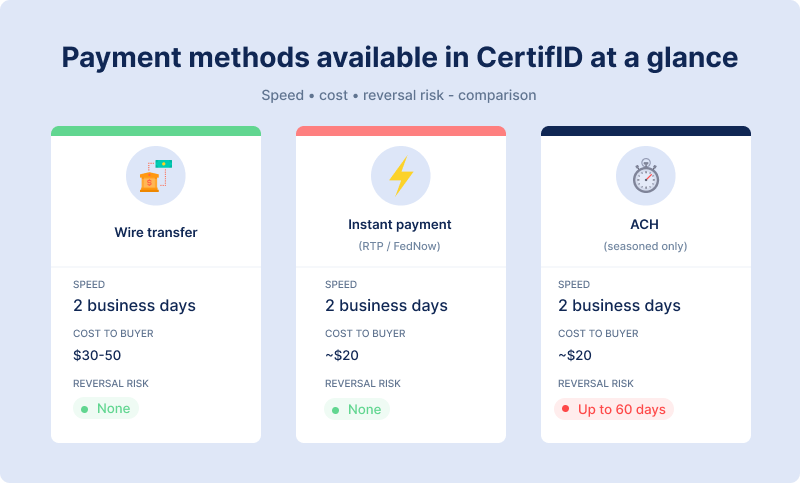
Funds can be delivered via ACH, Instant payment (RTP/FedNow), or Wire, depending on your state requirements and internal policies.
A two-business-day hold captures the vast majority of return scenarios before funds reach escrow. For title companies in strict good funds states, Instant and Wire delivery rails are widely recognized as meeting compliance requirements.
Fewer wires in your workflow means fewer opportunities for fraudsters to intercept instructions. For the transactions where a wire isn't required, that's worth considering.
Next steps to protect your business from wire fraud
While wire transfers typically can't be reversed, you can protect your business through prevention, quick action, and professional recovery services when needed.
The best defense is to double check all the details and support yourself with fraud prevention technology, and trained staff.
Stay informed about the latest wire fraud prevention strategies by subscribing to our weekly newsletter, The Wire.

FAQ
Can wire transfer details be abused against your account?

Yes. Wire transfer details contain sensitive banking information that fraudsters actively seek to intercept or manipulate. Once criminals have these details, they can create fake wire instructions, redirect funds to fraudulent accounts, and use the information for future scams.
Can you cancel a wire transfer?
It depends on the timing. During the initiation phase (first few minutes), cancellation is possible through your bank. Once the transfer enters the processing phase, cancellation becomes more difficult. After the receiving bank accepts the funds, cancellation is nearly impossible.
Can a bank wire transfer be reversed?
While banks can attempt to recall wire transfers, success largely depends on timing and circumstances. Once funds are accepted by the receiving bank, reversal becomes extremely unlikely. This is why prevention and immediate action are crucial if you suspect fraud.
Can you stop a wire transfer?
You can only stop a wire transfer during the initiation phase or early processing phase. After that, you'll need to work with law enforcement and recovery services like CertifID to attempt fund recovery.

Co-founder & Executive Chairman

Tom Cronkright is the Executive Chairman of CertifID, a technology platform designed to safeguard electronic payments from fraud. He co-founded the company in response to a wire fraud he experienced and the rising instances of real estate wire fraud. He also serves as the CEO of Sun Title, a leading title agency in Michigan. Tom is a licensed attorney, real estate broker, title insurance producer and nationally recognized expert on cybersecurity and wire fraud.
"I remember the exact moment I got the call from my office saying, 'We wired a payoff yesterday, and the lender just called us and said they didn't receive the wire.'"
For Sarah, a title agent with over 20 years of experience, this was the moment she learned a harsh truth: wire transfers are irreversible once completed.
It's a scenario that's becoming more common. According to CertifID's 2026 State of Wire Fraud Report, BEC attacks — the category that includes wire fraud targeting real estate closings — have surged 1,760% since generative AI tools became widely available. Fraudsters are faster, more convincing, and harder to detect than ever before.
Once a wire transfer is sent, reversing it is difficult and never guaranteed. Recovery is sometimes possible — CertifID's Fraud Recovery Services has helped return over $118.4 million in stolen funds with a 69% recovery rate — but speed is everything, and even successful recoveries come at high cost in time, stress, and uncertainty. Prevention is always a better outcome than recovery.
Read on to learn how wire transfers work, when reversal is possible, and how to protect your business before fraud has a chance to strike.
The truth about wire transfer reversals
Every case of wire transfer reversal is going to be different.
To better understand your options, look at what happens when you try to revoke a wire transfer.
Generally, the longer it has been since the official initiation of a wire transfer through the SWIFT network, the lower the chances of stopping your wire transfer.
If you discover your wire transfer may be fraudulent, check this short video for immediate action steps:
First, contact your bank, the FBI’s Internet Crime Complaint Center (IC3), and local law enforcement.
Banks and the SWIFT system perform anti-fraud checks, verify accounts, and may hold funds. This verification process typically takes 1-4 business days. It’s longer for international banks or when holidays are involved.
Your bank can use the SWIFT system’s Federal Reference Number to track the status of a transfer.
However, once a transfer is started and accepted by the receiving bank, it is nearly impossible to cancel the transfer or have all stolen money recovered.
At this point, you're no longer dealing with a wire reversal—you're dealing with wire fraud.
Why wire transfers are legally final
The legal basis for wire transfer finality is UCC Article 4A, adopted in all U.S. jurisdictions. Under UCC §§ 4A-209 and 4A-211, a wire transfer is accepted and final the moment funds are credited to the beneficiary's account. After that point, the transfer cannot be cancelled without the receiving bank's consent.
This statutory finality is why title companies bear direct liability when wires are misdirected. Unlike ACH transactions, which carry return rights for several business days, Fedwire transfers have no built-in reversal mechanism. The closing agent who sends a wire to a fraudulent account has, under the law, completed a final payment — regardless of the fraud that caused it.
This is precisely why prevention and verification before the wire is sent is the only legally reliable protection. Once the wire clears, your options narrow to recall requests and law enforcement — not rights.
Wire reversal vs. wire recall: what's the difference?
These two terms are often used interchangeably, but they describe different situations with different outcomes.
A wire reversal happens when a bank corrects an error it made — for example, if the bank sent the wrong amount, duplicated a transfer, or used the wrong account number.
In these cases, the bank is obligated to correct the mistake. Reversals are relatively straightforward when the error was the bank's.
A wire recall is a request made by the sending bank asking the receiving bank to voluntarily return funds. This is what happens when fraud is involved, or when the sender made a mistake.
The receiving bank has no legal obligation to comply. Under UCC Article 4A, once a wire is accepted — meaning it has been credited to the beneficiary's account — the payment is final. The receiving bank can only return funds voluntarily, and only if those funds haven't already been moved.
In real estate fraud cases, you are almost always dealing with a recall situation, not a reversal. That distinction matters because it determines your leverage and your timeline.
What to do if you sent a wire to a scammer
If you’re in real estate and suspect a wire transfer was fraudulent, every minute matters. Take these steps immediately:
First, contact your bank, the FBI’s Internet Crime Complaint Center (IC3), and local law enforcement.
Banks and the SWIFT system perform anti-fraud checks, verify accounts, and may hold funds. This verification process typically takes 1-4 business days. It’s longer for international banks or when holidays are involved.
Your bank can use the SWIFT system’s Federal Reference Number to track the status of a transfer.
However, once a transfer is started and accepted by the receiving bank, it is nearly impossible to cancel the transfer or have all stolen money recovered.
At this point, you're no longer dealing with a wire reversal—you're dealing with wire fraud.
When wire reversal fails: understanding the impact
And this is where the true nightmare may begin for your business.
Once the receiving bank accepts the transfer, the impact goes far beyond just lost customer funds.
Your business faces multiple risks:
- You may be personally liable for the lost funds
- Your professional license could be at risk
- Your company's reputation and client relationships may suffer
And court cases prove these aren't just theoretical considerations.
As outlined in our 2024 Sued for Wire Fraud Report, Authentic Title Services lost $480,750.96 to an email spoofing scam.
When they sought help from their insurer, the court denied their claim, stating their policy had "no obligation to pay any sums... for any claims based upon or arising out of the actual or alleged theft."
The company had to absorb the loss.
But, despite these serious risks, businesses aren't completely helpless when faced with wire fraud.
While prevention is ideal, there are several resources available if you find yourself dealing with fraudulent transfers.
Available wire fraud recovery resources
In addition to support from federal and local law enforcement and financial institutions, as a wire fraud victim, you have access to professional recovery services.
CertifID offers Fraud Recovery Services to help maximize your chances of getting money back:
- A team of fraud recovery experts
- 24/7 crisis communication hotline
- Expedited bank account freezing
- Additional federal law enforcement engagement
CertifID's Fraud Recovery Services have helped recover over $100 million in stolen funds for real estate businesses. Our team handles various types of wire fraud, including (but not limited to):
Business to business fraud
When fraudsters intercept communications and impersonate trusted vendors or partners.
For example, a title company discovers their settlement partner's email was spoofed after sending a wire.
In these cases, our recovery team could activate immediate account freezes while coordinating with law enforcement to track diverted funds.
Business to lender fraud
When criminals pose as legitimate lenders with fraudulent payoff statements.
For example, a title agency completes what seems to be a routine loan payoff, only to learn the real lender never received payment.
Our crisis team could initiate immediate trace requests while working with the United States Secret Service to intercept fraudulent transfers.
Business to consumer fraud
When fraudsters impersonate title companies and misdirect closing proceeds to fraudulent accounts.
For example, a title company's wire instructions are spoofed, causing them to unknowingly send closing funds to a fraudulent account.
Our 24/7 team could quickly engage with banks and law enforcement to maximize recovery chances within critical first hours.
The effectiveness of recovery efforts often depends on rapid response and expertise.
Do you remember Sarah’s story from the intro?
When her company fell victim to wire fraud, CertifID's coordination with federal law enforcement helped recover most of her funds—though she still faced a $168,000 loss.
This experience led her to implement stronger protections for her business and clients.
Are you a victim of wire fraud? Click the banner below to get help.
While recovery is possible in the right circumstances, it’s best not to let fraud happen.
So, prevention remains the most effective strategy. Let's explore proven practices for protecting your transactions from wire fraud.
How to safely wire money: 6 fraud prevention best practices
In this section, we’ll talk about tips to protect your wire transactions.
1. Establish consistent wire transfer processes
As a title agent, having a standardized process for every outgoing wire is your first line of defense against fraud.
Let's break down the essential procedures for two types of transactions:
For seller proceeds
Start by establishing a proactive approach to wire instructions. Collect these details during signing or before closing. When transmitting sensitive information, use only secure tools.
For example, to safely collect the seller’s bank details to be sure proceeds land in the right account, make a new request via CertifID.
Simply enter your seller's contact information, bank account number (ABA routing number), and closing details.
Then, CertifID sends them a secure link to provide their banking details.
The platform automatically validates their details and verifies their bank account information in under 60 seconds. No complex passwords or login credentials are needed.
Once verified, you'll receive a notification that you're ready to transfer funds, with each transaction insured up to $5 million per file.
For commission payments
As a title agent, disbursing money requires verification to ensure funds reach the correct brokerages.
In this case, say that you already have wiring instructions on your end. But you want to make sure they don’t belong to fraudsters.
Validate the information through CertifID's Confirm feature along with the identity check.
What you have to do is put in recipient information, property information, bank details, and credit details.
The other side will have to go through a verification process. Once both the identity of that broker as well as bank information are confirmed, you should get a “CERTIFID” status.
You can download it as a PDF, attach it to your title production software, and disburse funds.
Does CertifID sound like something for your title agency? Request a demo and our team of experts will get in touch and craft a customized offer just for your company.
2. Verify all participants' identities
Before sending any wire transfer, verify the identity of everyone involved in your real estate transactions.
This step is crucial as fraudsters increasingly target vacant properties and unencumbered land, impersonating legitimate sellers to quickly close all-cash deals below market value.
A multi-layered approach to identity verification is essential:
- Document validation: Verify government-issued IDs for authenticity
- Biometric matching: Ensure ID photos match the actual person
- Dynamic verification: Use real-time questions based on personal information
- Device analysis: Check if the device being used matches expected patterns
- Cross-reference verification: Compare information across multiple data sources
Remember that a single verification method isn't enough. Fraudsters have been known to pass individual checks like remote notarization or knowledge-based authentication.
Even validated IDs alone don't confirm that the person presenting them is legitimate. Each verification layer adds another data point, creating a more complete picture of someone's identity.
3. Watch for red flags (wire fraud scams)
Here are practical bullet points to help your team spot potential wire fraud.
Most attacks follow familiar patterns—whether it's business email compromise (BEC), impersonated lenders, or spoofed wire instructions.
Review these points for every transaction:
Timing red flags
- Is there an unusual urgency to wire immediately?
- Did the request come outside normal business hours?
- Is this happening before a holiday or weekend?
Communication red flags
- Are there variations in familiar email addresses?
- Does the email display name match the actual address?
- Are there grammar or spelling errors unusual for the sender?
Wire instruction red flags
- Are there multiple small adjustments to verified information?
- Do instructions reference overseas banks or accounts?
- Are there unusual routing requests or intermediate accounts?
Process red flags
- Is someone requesting verification outside of secure tools like CertifID?
- Are you receiving unexpected calls about pending transfers?
- Has anyone asked to bypass normal security procedures?
If any of these points is true for you, stop and perform additional verification steps. Remember: it's better to delay a legitimate transaction than to lose funds to fraud.
4. Secure payoff verifications
Verifying mortgage payoff instructions doesn't have to consume your day with manual reviews and endless lender callbacks.
Not to mention that some callback procedures take up to 30 minutes.
Fraudsters can intercept communications or use phishing emails to impersonate lender representatives. Even in these cases, you remain liable for any misdirected funds.
The best way to stay safe?
You can instantly validate payoff information through PayoffProtect, CertifID's verification platform.
Mortgage payoff fraud has two entry points: the request and the instructions. Most title companies focus on the second and ignore the first.
Manual payoff ordering means phone calls and emails to lenders. Each one is a touchpoint. Fraudsters can intercept that communication early and substitute fraudulent instructions before they ever reach your desk. By the time you receive what looks like a legitimate payoff statement, the compromise may already have happened.
Payoff Ordering removes that first exposure. The one-click solution automates payoff requests end-to-end. A centralized dashboard tracks real-time status across all active orders. Most complete within hours — no manual lender communication required.
Once instructions arrive, verify them before acting. Fraudsters also intercept later-stage communications and use phishing emails to impersonate lender representatives. In either case, you remain liable for misdirected funds.
Automated verification cross-references payoff details against thousands of verified lender records. The success rate is 97%+ in under a minute. When the system can't verify automatically, it flags the file for manual review rather than passing it through.
Manual callbacks, by comparison, take up to 30 minutes per file — and add no meaningful security advantage.
5. Train your team
Your front-line staff is your strongest defense against wire fraud. Create a good training program that includes the right due diligence.
Training program elements:
- Monthly fraud awareness sessions
- Real-world case study reviews
- Role-playing fraud scenarios
Operational procedures:
- Step-by-step verification checklists
- Documentation requirements
- Emergency contacts and escalation paths
Continuous development:
- Updates on emerging fraud schemes
- Industry compliance requirements
- Best practice implementation
Remember to test your team's knowledge regularly through simulated fraud attempts and provide immediate feedback on their responses.
These exercises strengthen your security and help team members bond over a shared mission to protect your clients and company.
6. Get good wire insurance
Many title companies are surprised to learn their standard E&O or cyber policies don't cover wire fraud losses.
Traditional policies often exclude social engineering fraud, fraudulent wire transfers, and theft of escrowed funds—leaving you exposed precisely when you need protection most.
Want to know what questions to ask your insurance agent? Watch this quick explanation:
When evaluating wire fraud insurance, look for these critical features:
Coverage elements:
- Direct first-party coverage for fraudulent transfers
- Protection against social engineering fraud
- Coverage for impersonation and spoofing attacks
- No exclusions for escrow or trust account losses
Policy traits:
- Clear coverage for funds held in escrow
- No requirement to prove a system breach
- Immediate response protocols
- Investigation and recovery support included
- Legal fees coverage for fraud-related issues
Remember: vendor policies protect them, not you. Review your current insurance stack to ensure you have specific coverage for wire fraud.
7. Consider whether every payment needs to be a wire
Wires are irreversible by design. That finality is what makes them appropriate for closing disbursements — but it also makes them a high-stakes target at every step of the transaction.
For earnest money deposits, the buyer initiates payment early in the process, often before robust verification is in place. Requiring a traditional wire at that stage means the buyer must source wire instructions — and those instructions are a known interception target.
Digital payment options now exist that carry the same fraud protection without the same finality risk for buyers.
Funds can be delivered via ACH, Instant payment (RTP/FedNow), or Wire, depending on your state requirements and internal policies.
A two-business-day hold captures the vast majority of return scenarios before funds reach escrow. For title companies in strict good funds states, Instant and Wire delivery rails are widely recognized as meeting compliance requirements.
Fewer wires in your workflow means fewer opportunities for fraudsters to intercept instructions. For the transactions where a wire isn't required, that's worth considering.
Next steps to protect your business from wire fraud
While wire transfers typically can't be reversed, you can protect your business through prevention, quick action, and professional recovery services when needed.
The best defense is to double check all the details and support yourself with fraud prevention technology, and trained staff.
Stay informed about the latest wire fraud prevention strategies by subscribing to our weekly newsletter, The Wire.
Co-founder & Executive Chairman
Tom Cronkright is the Executive Chairman of CertifID, a technology platform designed to safeguard electronic payments from fraud. He co-founded the company in response to a wire fraud he experienced and the rising instances of real estate wire fraud. He also serves as the CEO of Sun Title, a leading title agency in Michigan. Tom is a licensed attorney, real estate broker, title insurance producer and nationally recognized expert on cybersecurity and wire fraud.
Sign up for The Wire to join the conversation.






Austin
3601 South Congress Ave.
Ste D200, Austin, Texas 78704

Grand Rapids
124 Fulton Street E
Grand Rapids, MI 49503

